
Why Do Melanin Suppressants Exist, But Not Melanin Supporters?
Rethinking Pigment Through Biology, History, and Behavior
Walk into almost any beauty retailer today, and one message becomes impossible to ignore.
"Brighten."
"Fade dark spots."
"Correct discoloration."
"Reduce pigmentation."
"Even skin tone."
Whether displayed on pharmacy shelves, luxury department store counters, or social media advertisements, modern skincare is saturated with products promising to interrupt, suppress, or reduce melanin production. New tyrosinase inhibitors continue to enter the market, formulations compete to promise faster fading of pigmentation, and cosmetic chemistry has become remarkably sophisticated in its ability to interfere with the biological pathways responsible for pigment formation.
Yet despite this enormous investment, one question is rarely asked.
Why has the skincare industry become so skilled at suppressing melanin while spending comparatively little time discussing how to support the health of the very cells that produce it?
The question is not whether hyperpigmentation exists. It does. The question is not whether some pigment disorders deserve treatment. They do. The question is why our conversations so often begin with eliminating pigment rather than understanding why the skin produced it in the first place. That distinction may seem subtle. In reality, it changes everything.
Melanin Has Been Reduced to a Cosmetic Problem
One of the greatest oversimplifications in skincare education is the way melanin is introduced. Most esthetics students learn that melanin is "the pigment responsible for skin color." While technically correct, that definition captures only a fraction of melanin's biological importance. Melanin is not simply cosmetic. It is functional. It is adaptive. It is protective.
Long before humans formulated serums and brightening creams, melanin evolved as one of the body's remarkable defense systems. Produced by specialized cells known as melanocytes, melanin helps absorb ultraviolet radiation before it can damage DNA, reduces oxidative stress generated by environmental exposure, and contributes to the skin's ability to adapt to different climates across the globe.
When we reduce melanin to color alone, we ignore everything it was designed to do. Its purpose extends far beyond appearance. It participates in survival. That distinction is particularly important when discussing melanin-rich skin. Eumelanin, the predominant form of melanin found in darker skin, provides significantly greater photoprotection than pheomelanin, the lighter pigment more common among individuals of Northern European ancestry. This evolutionary adaptation helped populations living near the equator tolerate higher levels of solar radiation over thousands of years.
Melanin, therefore, is not evidence of a biological flaw. It is evidence of biological adaptation. Yet much of modern skincare continues to approach pigment as though it were primarily something to reduce.
Pigment Is Often the Messenger, Not the Disease
One of the first questions clients ask during a consultation is remarkably consistent. "How do I get rid of these dark spots?" It is a reasonable question. Hyperpigmentation can be frustrating, emotionally distressing, and cosmetically significant. But before asking how to remove pigment, perhaps we should ask a different question. Why did the skin create it?
Pigment does not usually appear without reason. It develops in response to information. Acne triggers inflammation. Inflammation activates melanocytes. Ultraviolet radiation damages DNA. Melanocytes increase pigment production to help protect surrounding tissues.
Mechanical injury, eczema, burns, hormonal fluctuations, allergic reactions, friction, and even overly aggressive skincare treatments can all stimulate pigment production.
In each of these situations, melanin is responding to biological signals. The pigment itself is not initiating the problem. It is responding to one.
Imagine visiting your physician because you have a fever. No responsible clinician would simply attempt to lower your temperature without first asking why your body developed a fever. The fever is a response. Similarly, hyperpigmentation is often the skin's response to injury, inflammation, or environmental stress.
Suppressing pigment without investigating the underlying trigger may improve appearance temporarily, but it does not necessarily address the biology that produced the pigment.
The Forgotten Cells: Understanding Melanocytes
Modern skincare spends an extraordinary amount of time discussing melanin. It spends surprisingly little time discussing melanocytes. That is unfortunate because melanocytes are among the most remarkable cells within the epidermis.
Far from functioning as passive pigment factories, melanocytes are highly responsive biological communicators. They continuously receive signals from neighboring keratinocytes, inflammatory mediators, hormones, ultraviolet radiation, oxidative stress, and mechanical injury.
They do not randomly produce pigment. They interpret information. When inflammation occurs, melanocytes respond. When ultraviolet exposure increases, melanocytes respond. When the barrier is repeatedly disrupted, melanocytes respond. Their behavior reflects the environment surrounding them.
This perspective shifts the conversation dramatically. Instead of viewing melanocytes as cells that "misbehave," we begin to recognize that they are often behaving exactly as biology intended.
The question then becomes: What is the skin trying to defend itself against?
A Behavior-Based Perspective
For decades, skincare has largely classified pigmentation according to appearance. We have developed elaborate systems to describe whether pigment is diffuse or localized, epidermal or dermal, superficial or deep. We have become remarkably skilled at naming what we see. But naming a condition is not the same as understanding why it developed.
A patch of post-inflammatory hyperpigmentation following acne does not arise through the same biological pathway as melasma. Likewise, pigmentation following eczema, friction, hormonal fluctuations, laser treatments, or chronic ultraviolet exposure may appear similar on the surface while originating from entirely different physiological processes. When these distinct biological events are treated as though they are the same condition, practitioners risk selecting interventions that address the appearance of pigment without addressing the behavior of the skin that produced it.
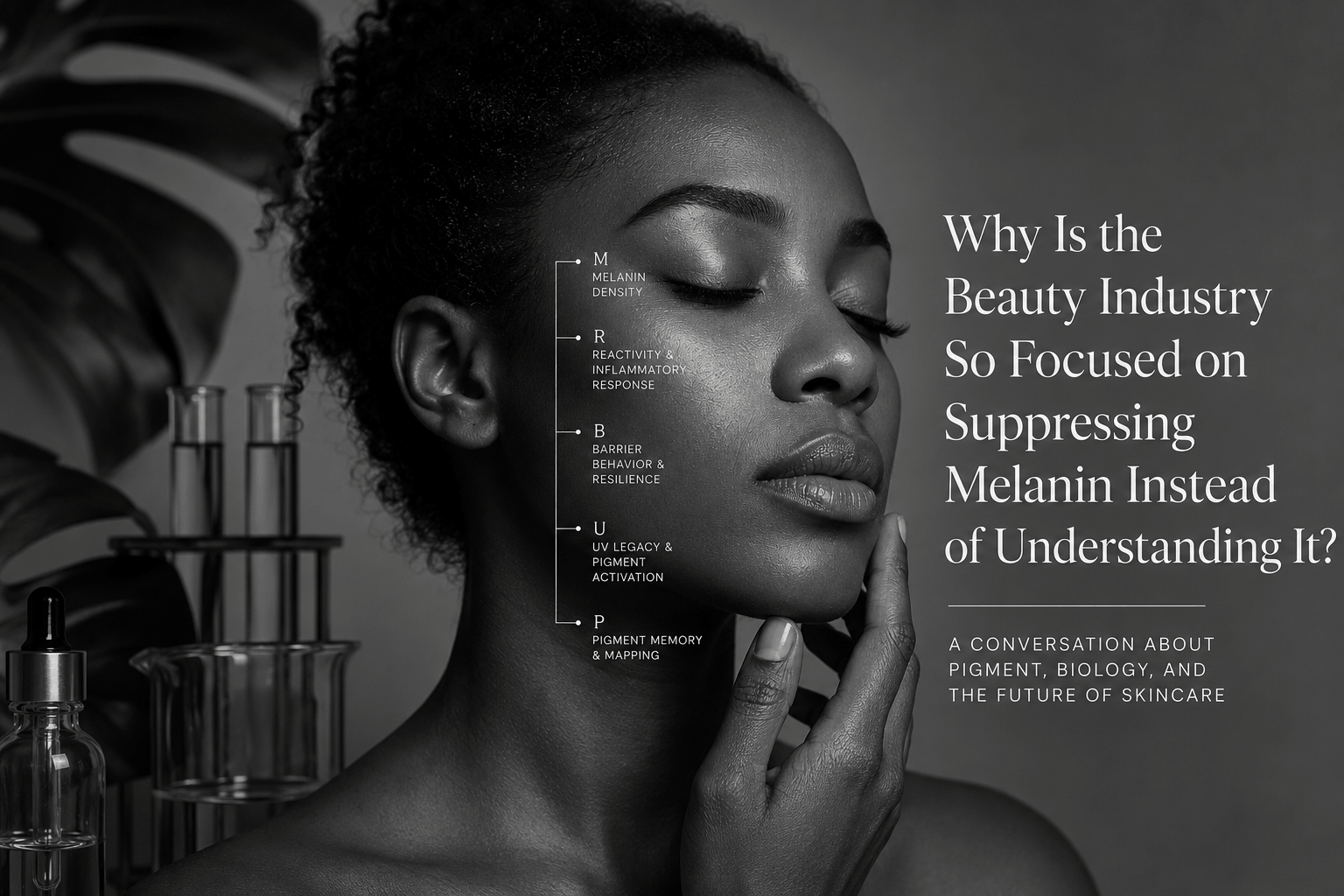
This realization became one of the driving forces behind the development of the MRBUP® Framework.
Rather than beginning with color alone, MRBUP® encourages practitioners to observe how the skin behaves before deciding how it should be treated. It is an educational observation framework built on the principle that skin is dynamic. It adapts, compensates, protects itself, and communicates continuously. Pigmentation is often one of the ways in which that communication becomes visible.
Instead of asking only, "What does this pigment look like?" the framework asks a more clinically useful question: "What is the skin responding to?"
That subtle shift transforms pigmentation from a cosmetic concern into a biological conversation.
M — Melanin Density
The first step is understanding the individual's baseline pigmentation instead of comparing it to generalized skin type charts or arbitrary classifications.
Melanin density influences far more than visible skin tone. It affects how ultraviolet radiation interacts with the epidermis, how inflammation may present clinically, how erythema can be masked, and how pigment may redistribute during wound healing. Appreciating an individual's natural melanin density establishes the foundation for interpreting every other observation that follows.
Rather than treating pigment as something excessive by default, the framework first asks practitioners to understand what is normal for that individual. Only then can changes be interpreted within the proper biological context.
R — Reactivity
Not all skin responds to injury in the same way. Two individuals may undergo the exact same treatment using the same products, performed by the same practitioner, yet experience completely different healing outcomes. One may recover uneventfully, while the other develops prolonged erythema, persistent inflammation, or post-inflammatory hyperpigmentation. The difference often lies not in the treatment itself, but in the skin's inflammatory behavior.
Inflammation is one of the most powerful regulators of melanocyte activity. Cytokines, prostaglandins, growth factors, and other inflammatory mediators influence whether melanocytes remain relatively quiet or become highly active. For many individuals with melanin-rich skin, it is this inflammatory cascade, not the pigment itself, that deserves the greatest clinical attention.
By evaluating inflammatory behavior first, practitioners begin treating one of the primary drivers of pigment dysregulation instead of focusing exclusively on the pigment left behind.
B — Barrier Behavior
Healthy pigment cannot exist independently of a healthy barrier. The epidermal barrier regulates water loss, protects against microbial invasion, limits environmental irritation, and maintains the biochemical environment in which epidermal cells, including melanocytes, function. When that barrier becomes chronically compromised, inflammation often follows. Repeated inflammation increases the likelihood of pigment alteration.
Many clients seeking treatment for discoloration have unknowingly spent months or years weakening their barrier through over-exfoliation, excessive acid use, harsh cleansers, or repeated procedures intended to "correct" pigmentation. Ironically, some attempts to eliminate pigment may contribute to the very biological stress that perpetuates it.
Within MRBUP®, barrier assessment is therefore not secondary to pigmentation, it is fundamental to understanding it.
U — UV Legacy
Ultraviolet exposure is not simply today's sunburn.
The skin records cumulative environmental experiences over time. Years of repeated ultraviolet exposure influence melanocyte behavior long after the original exposure has ended. DNA repair mechanisms, oxidative stress, collagen degradation, vascular changes, and melanocyte signaling all reflect this accumulated environmental history.
For some clients, current pigmentation cannot be understood without considering decades of ultraviolet exposure. For others, pigment may be more strongly influenced by inflammation than by sunlight. Distinguishing between these pathways allows treatment plans to become considerably more individualized.
The framework therefore examines ultraviolet history not merely as a measure of sun exposure, but as part of the skin's biological memory.
P — Pigment Memory
One of the most fascinating characteristics of melanin-rich skin is its tendency to remember.
Some areas of skin repeatedly develop pigmentation following relatively minor injury, while neighboring tissue heals without noticeable color change. Acne lesions recur in predictable locations. Friction produces recurrent discoloration. Previous inflammatory events leave biological footprints that influence future healing.
This phenomenon is what Beautélanin® describes as Pigment Memory.
Rather than viewing each episode of pigmentation as an isolated event, practitioners begin recognizing recurring behavioral patterns. Pigment Mapping then documents those patterns across the face or body, allowing future treatments to become increasingly preventive rather than reactive.
The goal is no longer simply to erase pigment after it appears.
The goal is to understand why the same skin continues responding in the same way.
A Different Way of Reading the Skin
Collectively, these five domains shift the practitioner's attention away from appearance alone and toward biology. Instead of asking, "How quickly can we fade this discoloration?" the conversation becomes:
What initiated this pigment response?
Which biological systems are involved?
Is the barrier functioning normally?
Is inflammation still active?
Has ultraviolet exposure altered melanocyte behavior?
Does this skin have a history of recurring pigment change?
Only after those questions are explored does treatment begin. That philosophy represents the central difference between conventional pigment management and the Beautélanin® approach.
We do not begin by asking how to suppress melanin.
We begin by asking what the skin is trying to tell us.
Beautélanin™ articles are for education only and do not replace medical advice.
