
Do Tears Activate a Chemical Peel?
The Truth Behind One of Esthetics' Most Persistent Myths
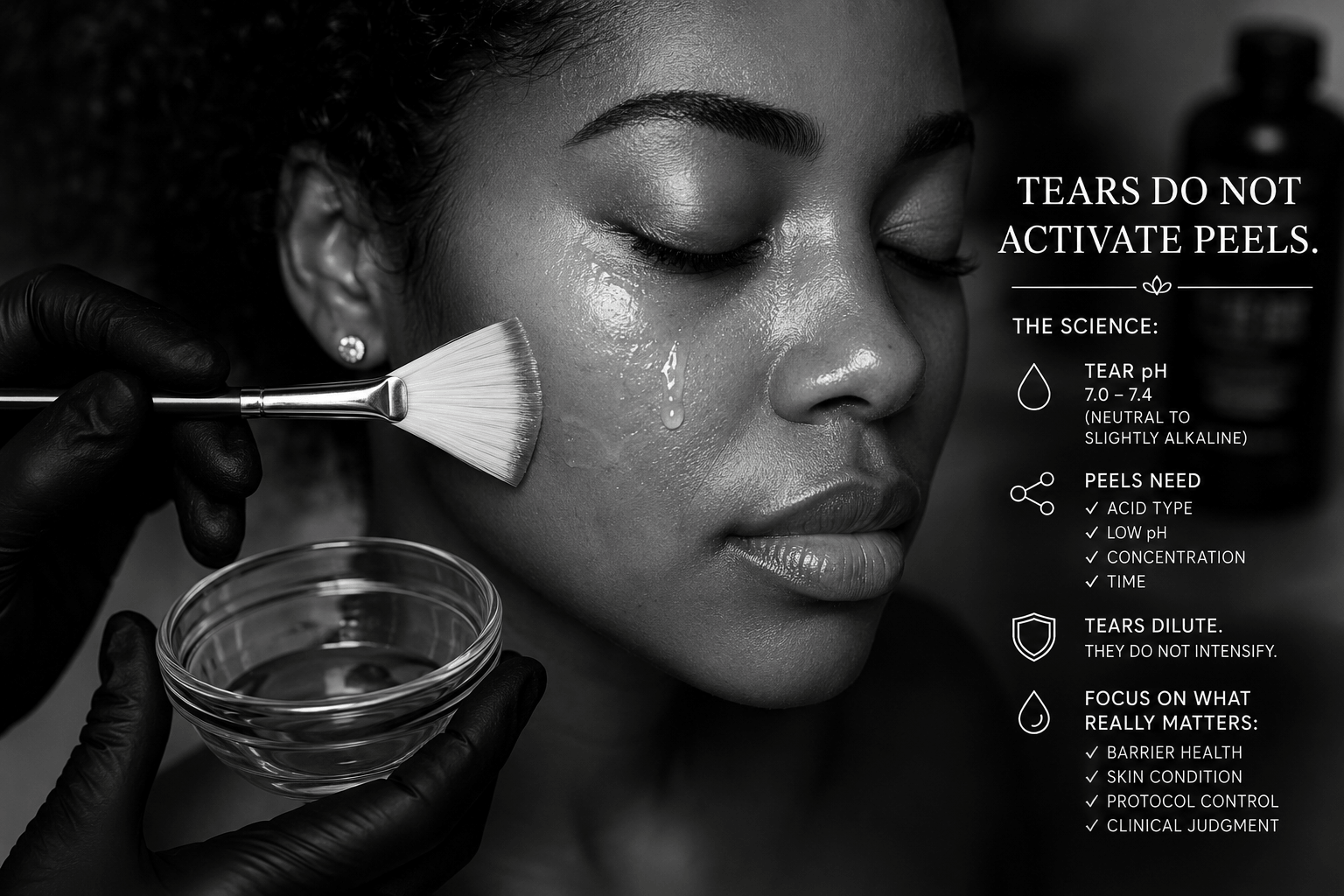
Black-and-white editorial photograph of a client receiving a professional chemical peel while tears form near the eye, illustrating the myth that tears activate chemical peels and emphasizing evidence-based esthetics.
Few statements have circulated through esthetics classrooms as often as this one:
"Be careful if your client cries—the tears will activate the peel."
It sounds believable.
Clients often experience watery eyes during chemical exfoliation, especially when acids are applied near the orbital area. Many practitioners notice that the client suddenly reports more stinging, and over time, a simple observation became accepted as fact. If a client begins to tear during a peel, the best response is to gently blot the area with a soft tissue and pause application if needed to ensure comfort and precision. This approach helps maintain a safe experience and reinforces your confidence in managing the treatment.
The problem is that it isn't true.
From a chemistry standpoint, tears do not activate chemical peels. Understanding why this myth persists requires us to understand how chemical peels actually work.
A Chemical Peel Doesn't Need to Be Activated
One of the most common misconceptions about chemical exfoliation is that something must "turn the peel on." In reality, a professionally formulated chemical peel is already active before it ever touches the skin. Its effectiveness is determined long before the treatment begins through careful formulation. (Bhardwaj et al., 2021)
Several factors influence how a peel performs, including:
The type of acid being used (AHA, BHA, PHA, TCA, or blended acids)
The concentration of the acid
The formulation's pH
Buffering systems
Contact time
The condition of the client's skin
These variables determine the peel's behavior. Water, steam, perspiration, and tears do not suddenly make the acid stronger. The chemistry has already been established inside the bottle.
What Tears Actually Contain
Human tears are remarkable biological fluids. Far from being acidic activators, they are composed primarily of:
Water
Electrolytes
Sodium and potassium salts
Proteins
Enzymes
Natural buffering compounds
Their average pH ranges from approximately 7.0 to 7.4, making tears neutral to slightly alkaline. (Chattopadhyay et al., 2023, pp. 733-743) Chemical peels, by contrast, function in an acidic environment. (Chemical Peels | Skin Inc., 2022)
Because tears are largely water with naturally buffering properties, they are far more likely to dilute small amounts of acid than intensify its activity. In fact, this dilution can sometimes cause the peel to become slightly less uniform in areas where tears are abundant, potentially weakening the exfoliating effect there. (Samargandy & Raggio, 2023) While the impact is usually minimal, practitioners should still gently blot away excess tears to maintain consistent results across the treated area.
From a biochemical perspective, tears move the environment away from acidity, not toward it.
Then Why Does It Feel Like the Peel Gets Stronger?
The answer lies in anatomy, not chemistry. The skin surrounding the eyes is among the thinnest on the human body. It contains abundant sensory nerve endings and responds more intensely to chemical stimulation than thicker areas of the face. As vapors from certain acids approach the eyes, or as treatment nears the orbital region, clients may instinctively begin tearing.
Those tears are a response to sensation. They are not the cause of increased chemical activity. The peel did not suddenly become stronger. The client simply entered one of the face's most sensitive anatomical regions.
How the Myth Was Passed Down
Like many long-standing beliefs within esthetics, this myth likely survived because observation was mistaken for causation. An instructor notices:
A peel approaches the eyes.
The client begins to tear.
The client reports increased stinging.
Over time, the conclusion becomes: "The tears activated the peel."
But correlation is not causation. Modern skin science encourages us to question traditions and distinguish anecdotal observations from biological mechanisms. Not every story passed from instructor to student reflects current scientific understanding.
What Actually Increases Peel Penetration?
While tears are harmless in this context, several real factors can influence how aggressively a peel behaves and the safety of the treatment. For client safety and best results, practitioners should focus their assessment on the following key risk factors before every peel:
A compromised skin barrier
Recent exfoliation, retinoid use
Over-cleansing before treatment, aggressive cleansing devices
Microdermabrasion before acids Heat
Steam immediately before treatment Existing inflammation
Occlusive products, inappropriate acid selection or concentration
Among these, the most important factors to check are: the integrity of the skin barrier, signs of recent or excessive exfoliation (including active retinoids), presence of inflammation, and any procedures or products that may increase sensitivity or penetration. Assessing and prioritizing these risks allows practitioners to tailor treatment for client safety, minimize irritation, and achieve more even results.
These are the variables practitioners should evaluate before every treatment. They influence penetration, irritation, healing, and ultimately client outcomes.
Why This Matters for Melanin-Rich Skin
For practitioners working with melanin-rich skin, repeating outdated myths can distract from the factors that truly matter. Instead, focus on supporting barrier health and preventing unnecessary irritation. For example, apply a thin layer of a gentle, non-occlusive barrier cream to sensitive areas before the peel to help protect the skin. Ensure that pre-peel protocols include thorough but non-aggressive cleansing, and consider lowering acid strength or contact time for first-time treatments. Always monitor closely for signs of discomfort or increased sensitivity, and prioritize calming, post-peel care to minimize the risk of post-inflammatory hyperpigmentation.
Melanin-rich skin is not inherently fragile. However, it often demonstrates a more robust pigment response following inflammation. When unnecessary irritation occurs, the risk of post-inflammatory hyperpigmentation (PIH) increases. (Shenoy & Madan, 2020)
That is why barrier integrity deserves far more attention than tears. An intact barrier helps regulate how the skin responds to chemical exfoliation. A compromised barrier may allow greater penetration, increased irritation, prolonged inflammation, and a higher likelihood of pigment alteration. (Samargandy & Raggio, 2023)
Barrier health, not tears, is one of the most important considerations in chemical peel safety.
A Barrier-First Perspective
At Beautélanin®, we encourage practitioners to move beyond folklore and toward evidence-informed decision-making.
Questions such as:
What is the current state of the skin barrier?
Has the client recently used retinoids?
Is there existing inflammation?
How reactive is this client's skin?
What is the appropriate acid for this presentation?
provide far more valuable information than worrying about whether a client becomes emotional during treatment.
Science and protocol should be guided by the latest research and established guidelines. Referencing current scientific literature and consensus in professional guidelines ensures that esthetic practice remains evidence-based and supports the best outcomes for clients and students. (Garelick et al., 2026)
Not myths.
The Beautélanin® Perspective
One of the responsibilities of modern esthetics is separating tradition from evidence. Some classroom teachings remain excellent. Others deserve to be revisited as our understanding of skin biology continues to evolve.
The belief that tears activate chemical peels belongs in the second category. The peel was already active. The tears were simply doing what tears have always done—protecting the eye.
Understanding that distinction allows practitioners to focus on what truly determines treatment safety:
Barrier integrity.
Inflammatory status.
Appropriate formulation.
Thoughtful clinical judgment.
Because successful chemical exfoliation is not controlled by emotion. It is controlled by chemistry.
References
Bhardwaj, V., Sharma, K., Maksimovic, S., Fan, A., Adams-Woodford, A. & Mao, J. (2021). Professional-Grade TCA-Lactic Acid Chemical Peel: Elucidating Mode of Action to Treat Photoaging and Hyperpigmentation. Frontiers in Medicine 8. https://doi.org/10.3389/fmed.2021.617068
Chattopadhyay, A., Tully, J., Shan, J., Sheikh, S., Ohliger, M., Gordon, J. W., Mauro, T. & Abuabara, K. (2023). Sodium in the skin: a summary of the physiology and a scoping review of disease associations. Clinical and Experimental Dermatology 48(7), pp. 733-743. https://doi.org/10.1093/ced/llad080
(2022). Chemical Peels | Skin Inc.. Skin Inc.. https://www.skininc.com/treatment/facial/article/22946054/chemical-peels
Samargandy, S. & Raggio, B. S. (2023). Chemical Peels for Skin Resurfacing. StatPearls - NCBI Bookshelf. https://www.ncbi.nlm.nih.gov/books/NBK547752/
Shenoy, A. & Madan, R. (2020). Post-Inflammatory Hyperpigmentation: A Review of Treatment Strategies. J Drugs Dermatol. 2020 Aug 1;19(8):763-768. https://doi.org/10.36849/JDD.2020.4887
Samargandy, S. & Raggio, B. S. (2023). Chemical Peels for Skin Resurfacing. StatPearls. https://doi.org/10.1007/978-1-62623-907-0_100
Garelick, E., Pohani, P., Aswani, A., Khan, S., Chadha, S., Patel, T. & Kebbe, M. B. (2026). Chemical Peels in Skin of Color: A Scoping Review of Safety, Efficacy, and Practice Patterns. Cureus 18(5). https://doi.org/10.7759/cureus.108851
Beautélanin™ articles are for education only and do not replace medical advice.
