
Should Every Client with Melanin-Rich Skin Receive Microneedling?
Why the MRBUP® Framework Begins with Behavior, Not the Device
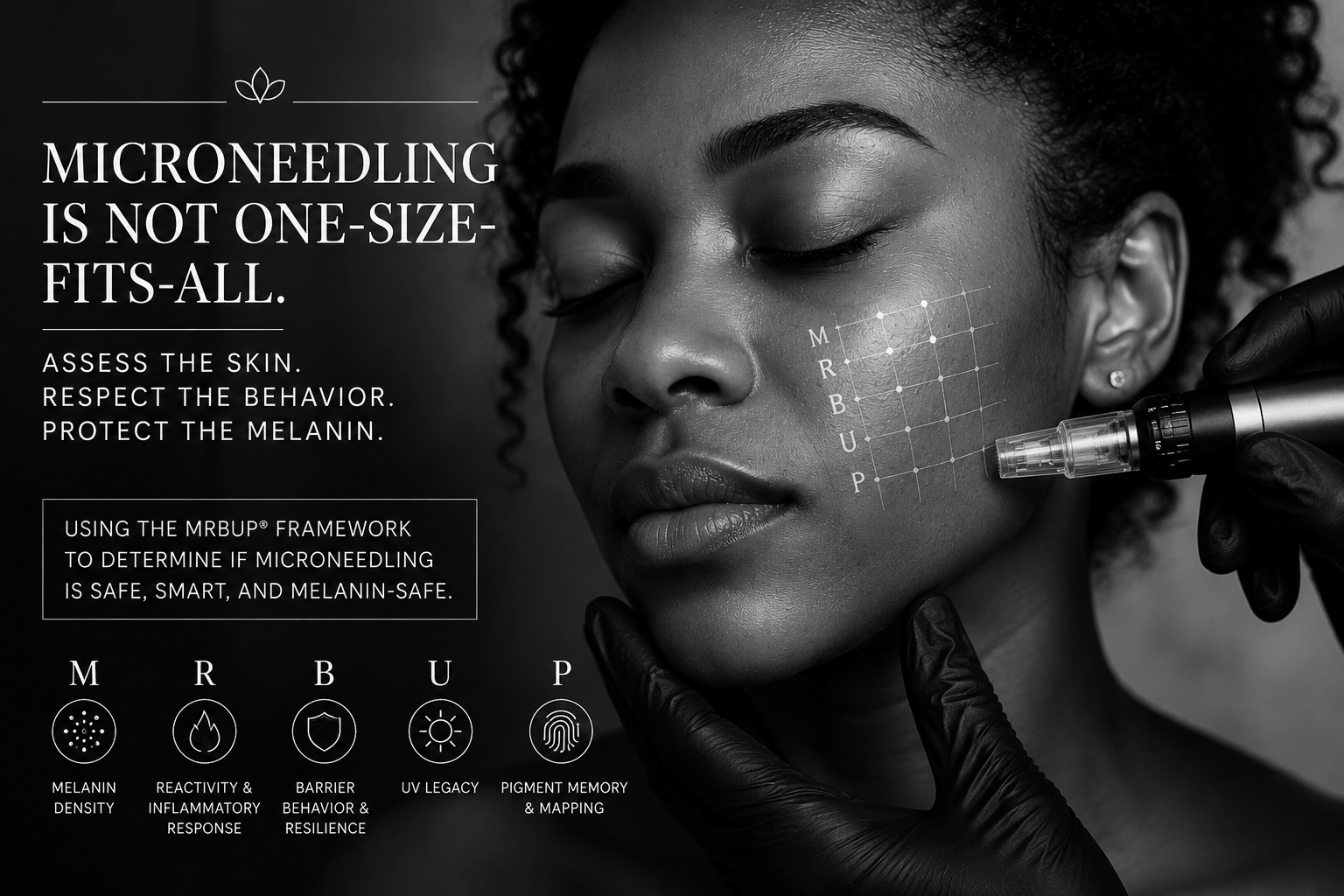
Microneedling should be performed with caution on melanin-rich individuals because it traumatizes the skin
Microneedling has become one of the most advertised procedures in aesthetic medicine.
Scroll through social media and you will likely see promises of smoother skin, smaller pores, softer scars, improved collagen production, and younger-looking skin, all achieved through hundreds of tiny needles creating controlled micro-injuries within the skin.
For some individuals, microneedling can be an appropriate treatment when performed by a properly trained professional acting within their legal scope of practice.
For others, particularly those with certain patterns of inflammation, pigment behavior, or impaired healing, the same procedure may carry greater risk than benefit.
At Beautélanin®, we believe the first question should never be: "Can I perform microneedling?" The first question should always be: "How is this skin behaving?" That distinction changes everything.
Microneedling Is Controlled Trauma
Every aesthetic procedure involves a biological response. Chemical peels create controlled chemical injury. Laser procedures generate controlled thermal injury. Microneedling creates controlled mechanical injury. The goal is not injury itself. The goal is stimulating the body's wound-healing response to encourage collagen remodeling and tissue repair. Whether that response becomes beneficial or problematic, depends largely upon how the individual's skin responds to injury.
The Skin Doesn't Read Marketing
Advertisements often suggest that microneedling works similarly for everyone, but biology disagrees. Two people may undergo identical procedures using the same device, needle depth, and protocol while experiencing completely different outcomes. One heals uneventfully. Another develops prolonged inflammation. Another develops post-inflammatory hyperpigmentation. Another forms hypertrophic scarring. The device did not change, but the skin did.
The MRBUP® Perspective
The MRBUP® Framework doesn’t begin with the treatment, it begins with observation. The framework asks practitioners to evaluate five interconnected domains before selecting any procedure. Not every client will demonstrate the same pattern across these domains, even when their skin tone appears similar.
M — Melanin Density
Melanin density alone does not determine whether microneedling is appropriate. Instead, practitioners should ask:
How densely pigmented is the treatment area?
Is pigment distributed uniformly?
Has the client previously developed prolonged discoloration after injury?
The concern is not melanin itself. The concern is how the skin has historically responded to injury.
R — Reactivity
This may be one of the most important considerations. Ask:
Does the client flush easily?
Is chronic inflammation present?
Does the skin remain irritated for extended periods?
Is there active acne, dermatitis, eczema, or rosacea?
Microneedling intentionally initiates inflammation. If inflammation is already excessive, creating additional injury may not be appropriate.
B — Barrier Behavior
Barrier health determines how well the skin tolerates controlled injury.
Observe:
Chronic dehydration
Excessive transepidermal water loss (TEWL)
Recent over-exfoliation
Retinoid irritation
Barrier compromise
Delayed healing
A weakened barrier often predicts a more difficult recovery. Sometimes restoring the barrier first provides better long-term outcomes than proceeding immediately with microneedling.
U — UV Legacy
Recent ultraviolet exposure significantly influences healing.
Questions include:
Has the client experienced significant recent sun exposure?
Is sunscreen used consistently?
Does the client frequently tan or burn?
Is there existing UV-induced pigmentation?
Freshly injured skin becomes more vulnerable to ultraviolet damage. Post-procedure photoprotection becomes essential.
P — Pigment Memory
Perhaps the most overlooked domain. Every client's skin remembers previous injury.
Ask:
Has the client previously developed PIH?
Have insect bites left persistent marks?
Do scratches become dark for months?
Have previous cosmetic procedures altered pigmentation?
Is there a history of hypertrophic or keloid scarring?
Previous healing patterns often provide better predictive information than skin tone alone.
When the Framework Suggests Waiting
Sometimes the safest treatment is no treatment.
The MRBUP® Framework encourages practitioners to postpone procedures when the skin demonstrates behaviors that increase the likelihood of complications. Supporting barrier recovery, reducing inflammation, improving home care, or addressing UV exposure first may significantly improve future treatment outcomes. Do not look at waiting as a failure; it is clinical judgment.
A Note About Scope of Practice
Scope of practice varies considerably by jurisdiction.
In New York, estheticians are not authorized to perform microneedling under current law.
Practitioners should always understand and comply with the regulations governing their professional license before offering any procedure.
Even in jurisdictions where microneedling falls within an esthetician's scope of practice, legal authorization does not replace thoughtful clinical assessment.
Being permitted to perform a treatment does not automatically mean every client is an appropriate candidate.
The Beautélanin® Perspective
At Beautélanin®, we believe devices should never dictate treatment decisions; Skin behavior should. Microneedling is neither inherently good nor inherently harmful. It is simply one tool. Like every tool in aesthetics, its value depends upon the biology of the individual receiving it. That is why our approach begins with observation.
Not assumptions.
Not trends.
Not marketing.
Behavior first.
Treatment second.
Because the most successful procedure is not always the most aggressive one. Sometimes the most advanced decision a practitioner can make is recognizing that today's best treatment is preparation, not penetration.
The question isn't whether the device can be used. The question is whether this skin is ready for it.
Beautélanin™ articles are for education only and do not replace medical advice.
