
Why Exfoliate After Waxing?
And Why Timing Matters More Than Most People Realize
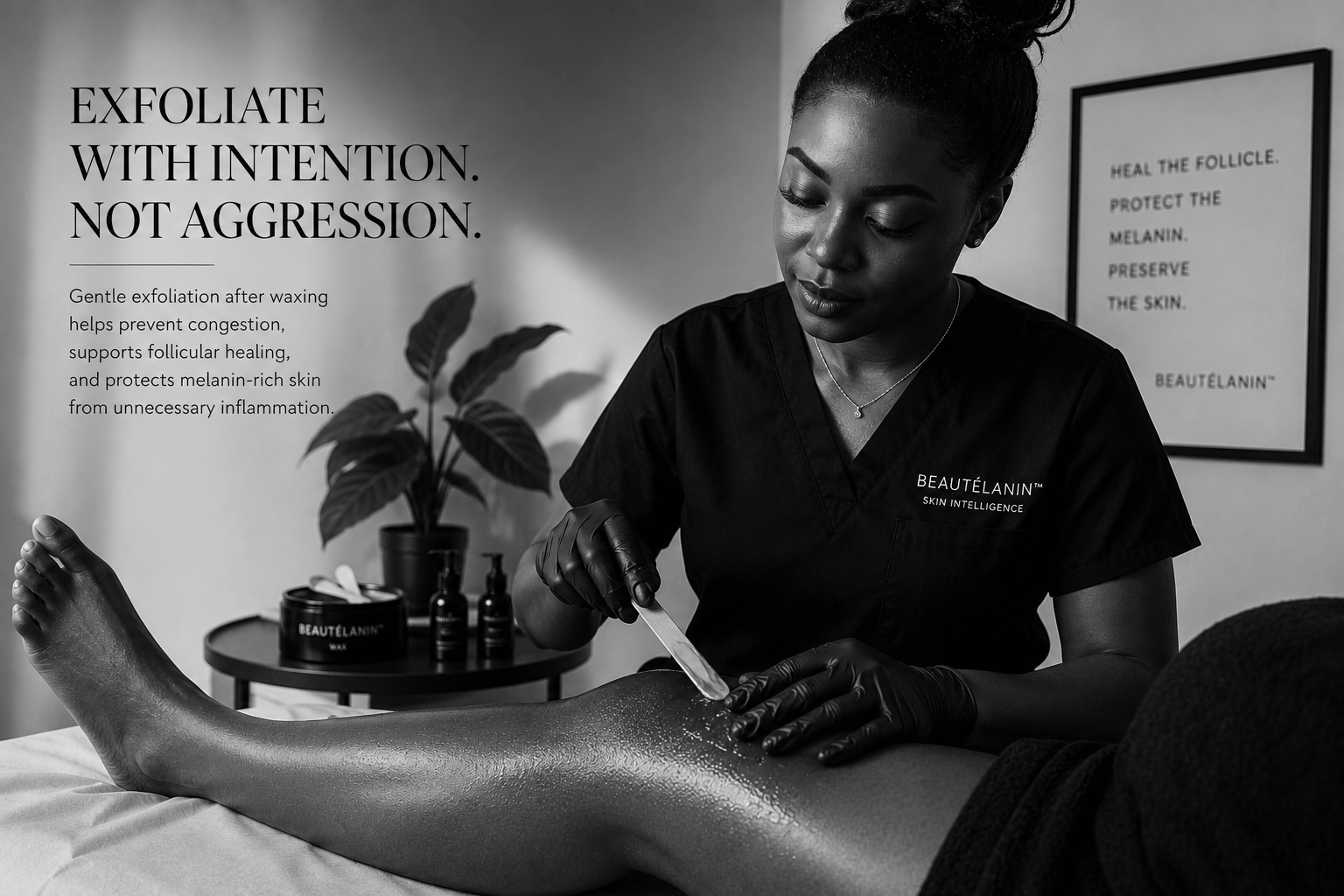
A black-and-white editorial photograph illustrating melanin-safe waxing and post-wax care
Waxing removes more than hair.
When a hair is extracted from the follicle, the skin enters a period of recovery. The follicular opening remains temporarily widened, the surrounding tissue shows mild inflammation, and the skin barrier begins to restore itself. (Wang et al., 2020). While these changes are a normal part of healing, they also create a window during which the skin becomes more vulnerable to irritation, congestion, and post-inflammatory pigmentation.
For this reason, exfoliation after waxing is often recommended. However, the purpose of post-wax exfoliation is frequently misunderstood. The goal is not to make the skin smoother. The goal is to support the healing follicle.
As the follicle recovers, dead skin cells, sebum, sweat, and environmental debris can accumulate around the opening. If this buildup becomes excessive, newly emerging hairs may struggle to exit the follicle properly. The result can be ingrown hairs, follicular congestion, inflammation, and, in many individuals with melanin-rich skin, lingering post-inflammatory hyperpigmentation. (Khanna et al., 2014, pp. 849-854)
Gentle exfoliation helps reduce this buildup and encourages the hair to emerge normally as the follicle heals. (Post Wax Care, 2023)
The timing, however, is critical.
Immediately after waxing, the skin barrier is already compromised. The follicle has sustained mechanical trauma; inflammation is present, and the skin is actively repairing itself. Introducing exfoliants during this period may increase irritation, create additional barrier disruption, and trigger unnecessary inflammation. (Symanzik et al., 2022, pp. 241-246)
For melanin-rich skin, inflammation carries additional consequences. (A chronic pro-inflammatory environment contributes to the physiopathology of actinic lentigines, 2024). Every inflammatory event has the potential to become a pigment event. (Hamzavi et al., 2017, pp. 591-603)
What begins as mild irritation may later present as hyperpigmentation that remains visible long after the original inflammation has resolved. (Elbuluk et al., 2021, pp. 829-836)
This is why exfoliation should never begin immediately after waxing.
Instead, allow the skin to recover for approximately 48 to 72 hours after waxing. (Wax Aftercare, n.d.) This gives the initial inflammatory response time to subside. Begin gentle exfoliation at this point—48 to 72 hours after waxing—to help keep the follicle clear without overwhelming the skin's repair processes. Clear timing ensures you support healing and minimize the risk of irritation or complications.
Not all exfoliants are created equally.
Many traditional waxing protocols recommend aggressive scrubs, high-strength acids, or "brightening" products that prioritize rapid turnover over barrier integrity. While these approaches may appear effective in the short term, they often introduce unnecessary irritation, particularly for individuals prone to post-inflammatory hyperpigmentation. (Zafar et al., 2026)
At Beautélanin™, we favor approaches that support recovery rather than challenge it. Gentle enzymes, such as those found in papaya, pumpkin, or pineapple, can help loosen surface buildup without excessive friction. Products like enzyme masks or enzyme-infused gel pads are excellent options for clients who want to exfoliate gently. Polyhydroxy acids (PHAs), including ingredients like gluconolactone and lactobionic acid, provide mild exfoliation while supporting hydration; these are often available in toner form, pre-soaked pads, or light gel-serums. Botanical ingredients such as aloe, calendula, licorice root, and tamanu may further support skin comfort during recovery and are often found in calming gel formulas or hydrating mists. (Hernandez, 2022) When shopping, look for gentle enzyme-based masks, PHA toners or pads, and calming botanical gels to best support post-wax recovery.
Equally important is knowing what to avoid.
Retinoids, aggressive alpha hydroxy acids, high-strength salicylic acid treatments, alcohol-based toners, and abrasive physical scrubs can all increase irritation when introduced too soon after waxing. (Best and Worst Skincare Actives for Post-Wax Care, 2026) The skin does not need additional challenges during healing. It needs support.
Avoid these for at least a week after waxing:
- Retinoids (including prescription and over-the-counter)
- Strong alpha or beta hydroxy acids (AHA/BHA)
- High-strength salicylic acid products
- Alcohol-based toners
- Gritty or abrasive physical scrubs
- Peels or strong exfoliating treatments
Keeping this simple list in mind helps protect the skin as it recovers. This reflects a broader principle of melanin-centered skin care.
Exfoliation should assist recovery, not force turnover.
The goal is not to polish the skin into submission. The goal is to create conditions that allow the follicle to heal properly, the barrier to recover efficiently, and the skin to maintain its natural balance.
When approached thoughtfully, post-wax exfoliation becomes less about removing skin and more about supporting the biological processes already taking place beneath the surface. For most people, gentle exfoliation two to three times per week is sufficient to keep follicles clear without overwhelming the skin. Those with sensitive skin may prefer exfoliating just once a week, while individuals with oilier skin types may tolerate more frequent exfoliation. (Hong et al., 2020, pp. 1016-1020) Adjust the routine based on your skin's response, a little consistency goes a long way toward supporting healing and preventing complications.
Because healthy skin is not achieved through force.
It is achieved by respecting how the skin heals.
References
Wang, Z., Luo, J. & Li, J. (2020). Hair regeneration after epidermal peeling. Eur J Dermatol. https://doi.org/10.1684/ejd.2020.3744
Khanna, N., Chandramohan, K., Khaitan, B. K. & Singh, M. K. (2014). Post waxing folliculitis: a clinicopathological evaluation. International Journal of Dermatology 53(7), pp. 849-854. https://doi.org/10.1111/ijd.12056
(2023). Post Wax Care. The Epilation Lab. https://mysite.vagaro.com/theepilationlab/post-wax-care
Symanzik, C., Kezic, S., Jakasa, I., Skudlik, C., John, S. M., Brans, R. & Sonsmann, F. K. (2022). Effects of skin washing frequency on the epidermal barrier function and inflammatory processes of the epidermis: An experimental study. Contact Dermatitis 87(3), pp. 241-246. https://doi.org/10.1111/cod.14119
Zafar, K., Kabakova, M., Joerg, L. & Jagdeo, J. (2026). An Investigator-Developed Regimen for Treatment and Prevention of Post-Inflammatory Hyperpigmentation in Skin of Color. J Drugs Dermatol. 2026;25(4):330-336. https://doi.org/10.36849/jdd.9437
Elbuluk, N., Grimes, P., Chien, A., Hamzavi, I., Alexis, A., Taylor, S., Gonzalez, N., Weiss, J., Desai, S. R. & Kang, S. (2021). The Pathogenesis and Management of Acne-Induced Post-inflammatory Hyperpigmentation. American Journal of Clinical Dermatology 22(6), pp. 829-836. https://doi.org/10.1007/s40257-021-00633-4
Hernandez, A. (2022). PHA Breakdown: A Guide to Polyhydroxy Acids in Skin Care. Skin Inc.. https://www.skininc.com/science/ingredients/article/22591854/face-reality-skin-care-acne-clinic-pha-breakdown-a-guide-to-polyhydroxy-acids-in-skin-care
(2026). Best and Worst Skincare Actives for Post-Wax Care. Waxbead.com. https://waxbead.com/which-rising-skincare-actives-belong-in-post-wax-products-an
Hong, J. Y., Park, S. J., Seo, S. J. & Park, K. Y. (2020). Oily sensitive skin: A review of management options. Journal of Cosmetic Dermatology 19(5), pp. 1016-1020. https://doi.org/10.1111/jocd.13347
(n.d.). Wax Aftercare. Fifth Element Esthetics. https://www.fifthelementesthetics.com/pages/wax-aftercare
Hamzavi, I., Chaowattanapanit, S., Silpa-Archa, N. & Lim, H. W. (2017). Postinflammatory Hyperpigmentation: A Comprehensive Overview: Epidemiology, Pathogenesis, Clinical Presentation, and Noninvasive Assessment Technique. Journal of the American Academy of Dermatology 77(4), pp. 591-603. https://doi.org/10.1016/j.jaad.2017.01.035
(2024). A chronic pro-inflammatory environment contributes to the physiopathology of actinic lentigines. Scientific Reports. https://doi.org/10.1038/s41598-024-53990-5
Beautélanin™ articles are for education only and do not replace medical advice.
