
The Greatest Risk Isn't What Milady Teaches—It's What Clients Don't Tell You
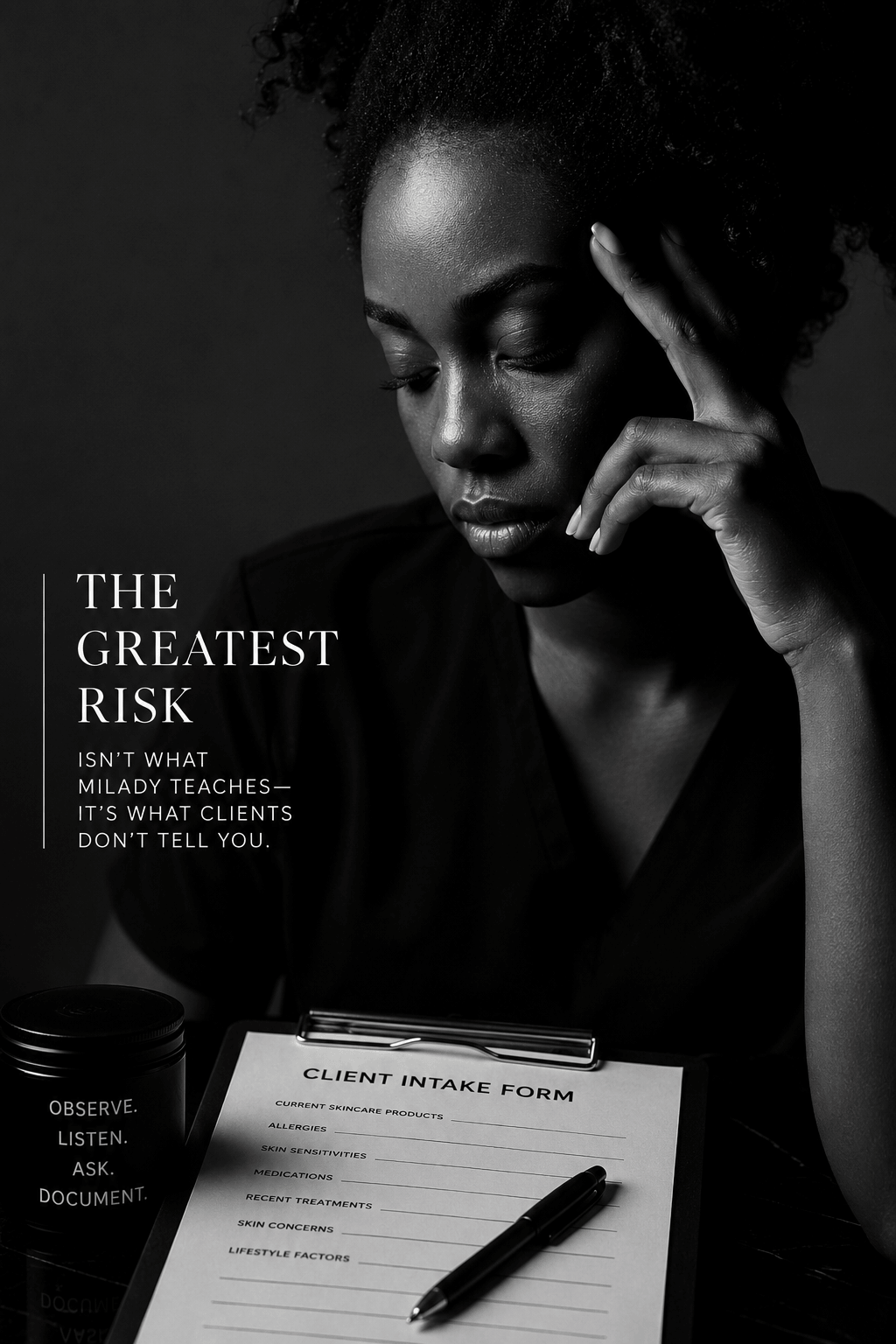
The greatest risk is often not what the client tells you—it's what they don't know to tell you."
— Beautélanin™
Milady devotes significant attention to infection control, disinfection procedures, cross-contamination, pathogens, personal protective equipment, and sanitation standards. These topics are essential. Every esthetician should understand how to maintain a safe treatment environment and reduce the risk of infection.
However, in everyday practice, the greatest challenge facing most estheticians is rarely a failure in sanitation.
More often, it is incomplete information. For example, imagine a client who forgets to mention using an over-the-counter acne cream with strong active ingredients the night before her facial. During the treatment, her skin suddenly becomes red and irritated. Only later does she recall that detail, which turns out to be the key factor behind her reaction. This kind of oversight is common and can lead to unexpected complications, even when all proper protocols have been followed.
The most significant risks frequently arise not from what we know, but from what we do not know.
Clients rarely withhold information out of malice. In many cases, they simply do not realize that certain details are relevant. They may forget to mention a product they used the night before. They may not understand the difference between an allergy and an irritation. They may assume that a reaction that occurred months ago is no longer important. Sometimes they genuinely believe their skin is "not sensitive" because they have never experienced an obvious adverse reaction.
The challenge is that clients are not trained skin professionals.
Many do not fully understand the distinctions between sensitivity and allergy, irritation and inflammation, dryness and dehydration, congestion and acne, or exfoliation and barrier damage. For example, sensitivity generally refers to the skin's tendency to react to certain products or environments, while an allergy is an immune response to a specific substance. Irritation is often caused by external factors, such as overuse of a product, whereas inflammation is the skin's broader response to injury or stress. Dryness means a lack of oil in the skin, while dehydration refers to a lack of water. Congestion is a buildup of debris or oil in the pores, whereas acne involves inflammation and sometimes infection. Exfoliation removes dead skin cells, but if overdone, it can lead to barrier damage, which is the weakening of the skin’s protective layer. They often use language based on personal experience rather than clinical understanding.
Ironically, some of the most challenging consultations involve clients who are highly confident about their skin.
Statements such as:
"I have perfect skin."
"I never react to anything."
"My skin is tough."
"I don't have allergies."
"I can use anything."
It may sound reassuring, but they can sometimes signal limited awareness of how the skin actually behaves. Confidence is not always the same as knowledge.
A client may believe they have no sensitivities while simultaneously using multiple active ingredients, over-exfoliating at home, experiencing chronic dehydration, or unknowingly compromising their barrier function.
This is why the consultation process is so important. To make consultations more effective, it helps to follow a structured approach. Here are a few essential steps that can make a difference:
Begin with open-ended questions about the client’s general health, lifestyle, and skin goals.
Ask specifically about all products currently used, including over-the-counter items, prescriptions, and any recent changes to their routine.
Inquire about recent procedures or treatments, such as waxing, chemical peels, or laser services.
Ask about any allergies, past reactions, or sensitivities, even if they seem unrelated.
Observe the client's skin closely and note your own findings alongside their reported history.
Clarify any vague or unclear answers, and encourage clients to share small details that might seem insignificant.
By following these steps and asking thoughtful questions, you can help uncover important information that clients might otherwise overlook.
Consider a client who arrives wearing full makeup, changes appointment times multiple times, struggles to identify the products they use at home, fails to recognize signs of barrier impairment, or does not understand how their skin responds to sun exposure. None of these factors necessarily indicates dishonesty. They simply illustrate how little many consumers have been taught about their own skin.
And this is where professional judgment becomes critical.
The complications that most concern estheticians often have little to do with disinfection procedures. Instead, they arise from undisclosed or misunderstood factors such as recent shaving, waxing, retinoid use, sun exposure, home exfoliation practices, medication changes, allergies, skin sensitivities, or pre-existing barrier dysfunction.
When an adverse reaction occurs, clients frequently look to the treatment provider for answers. Whether or not the treatment itself caused the reaction, the esthetician often becomes the most visible point of accountability.
This is why documentation matters. Keeping clear, accurate records of each client’s consultation, treatment plan, any information they share, and observations you make during their visit is essential. Good documentation should include the client's medical history, allergies or sensitivities, current products and medications, details of procedures performed, and any reactions or aftercare discussed. This protects both you and your clients by providing a point of contact in the event of questions, concerns, or adverse reactions. Organized records help ensure continuity of care, facilitate safe decision-making, and demonstrate professionalism.
This is why thorough consultations matter.
This is why conservative decision-making matters.
Ultimately, esthetics is not simply about products, treatments, or skin physiology. It is also about communication, observation, and risk assessment. It requires practitioners to recognize not only what clients tell them, but also what clients may not know to disclose.
The most valuable skill an esthetician can develop is not the ability to perform a treatment.
It is the ability to ask better questions.
For example, here are some consultation questions that can help uncover important details clients might not think to share:
Can you walk me through your full skincare routine, including any products you use occasionally or have tried recently?
Have you noticed any changes in your skin since your last appointment or after starting any new medications or supplements?
Are there any treatments, procedures, or products (at home or professionally) that you have used in the last two weeks?
Have you experienced any redness, itching, stinging, or unusual sensations after using a product, even if it seemed minor?
Do you use any topical or oral medications for your skin, including over-the-counter products?
How does your skin typically respond to sun exposure, temperature changes, or stress?
Are there any specific events coming up that might affect what you want from today's treatment?
Is there anything about your health or lifestyle that you think could be relevant to your skin, such as recent travel, hormonal changes, or changes in your diet?
By asking practical, open-ended questions like these, you help clients reflect and share details they may otherwise forget, making your consultations safer and more effective.
Because successful skin care depends as much on understanding people as it does on understanding skin.
Beautélanin™ articles are for education only and do not replace medical advice.
