
Viewing Vitamin D Through the MRBUP® Framework
How Barrier Integrity, UV Exposure, Inflammation, and Melanin Shape the Skin’s Relationship With Vitamin D
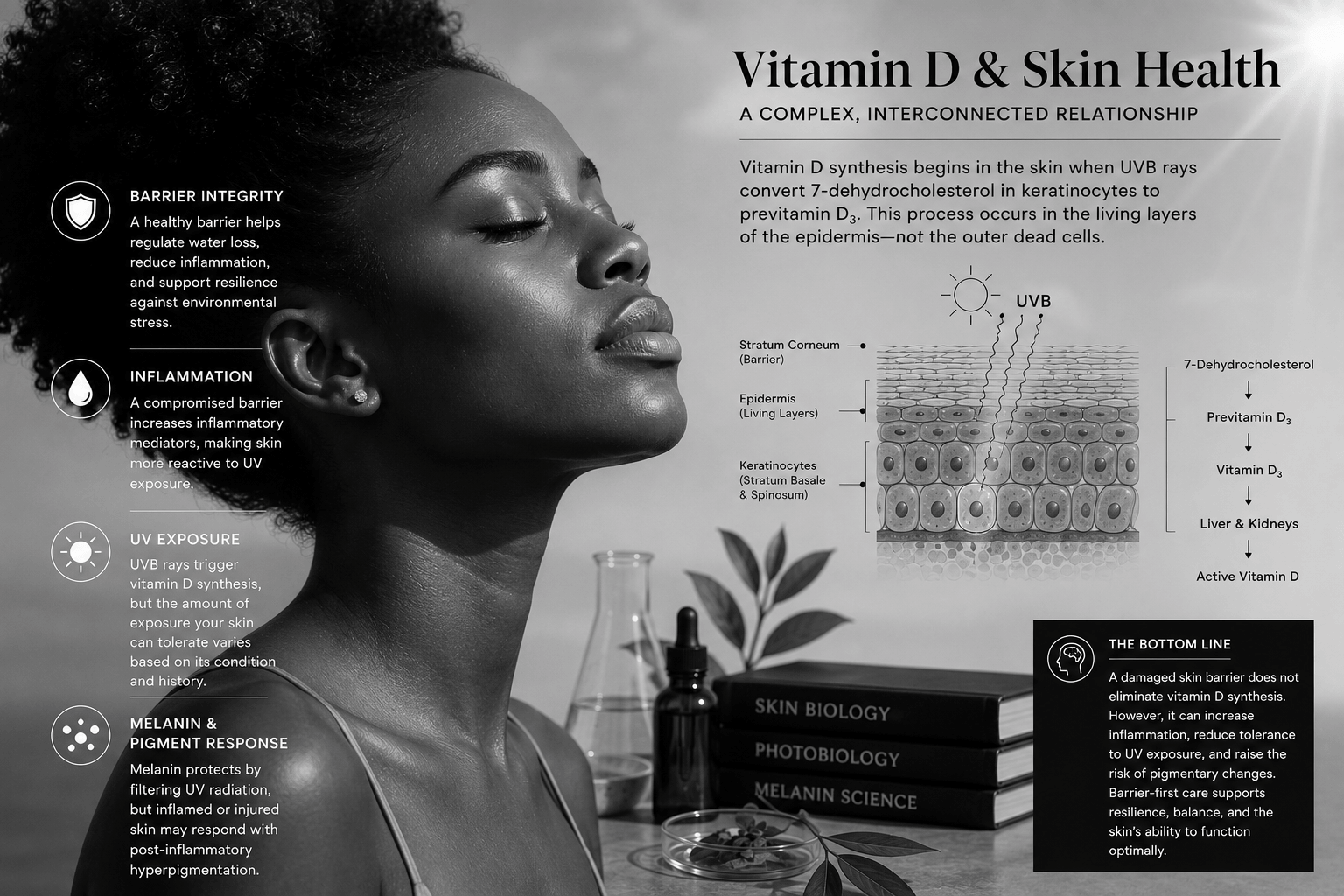
A healthy skin barrier does not produce vitamin D directly, but it shapes how the skin tolerates ultraviolet exposure, regulates inflammation, and supports the biological environment in which vitamin D synthesis occurs.
One of the principles underlying the MRBUP® Framework is that biological processes rarely occur in isolation. Vitamin D synthesis, barrier integrity, inflammation, ultraviolet exposure, and pigmentation are not independent events occurring in separate compartments of the skin. They influence one another continuously. Understanding those relationships allows practitioners to move beyond simplified cause-and-effect explanations and toward a more comprehensive interpretation of skin behavior.
From an MRBUP® perspective, the question is not simply whether ultraviolet light can stimulate vitamin D production. The more meaningful question is how this particular individual's skin is likely to respond to the ultraviolet exposure required to initiate that process.
Each of the five observational domains offers a different piece of that answer.
m—Melanin Density
Melanin density influences how ultraviolet radiation penetrates the epidermis, but it should never be interpreted as a biological limitation or deficiency. Higher concentrations of eumelanin provide important photoprotective benefits by absorbing portions of ultraviolet radiation before it reaches deeper tissues. This protection is an evolutionary advantage, not an obstacle. Appreciating natural melanin density allows practitioners to understand why individuals may experience different patterns of ultraviolet exposure without reducing those differences to simplistic assumptions.
R—Reactivity
Not every individual's skin responds to ultraviolet exposure in the same manner.
Some experience minimal irritation following moderate sun exposure, while others develop significant inflammation after relatively brief exposure. Because inflammation itself influences melanocyte behavior, practitioners must recognize that ultraviolet exposure intended to support physiological processes may simultaneously trigger pigmentary complications in susceptible individuals. The inflammatory response therefore becomes just as clinically important as the ultraviolet exposure itself.
b—Barrier Behavior
Barrier integrity determines how comfortably the skin interacts with its environment.
A resilient barrier helps regulate hydration, limits excessive transepidermal water loss, and supports recovery following environmental stress. When the barrier is compromised, ultraviolet exposure may produce disproportionate irritation relative to the amount of exposure received. The issue is no longer whether vitamin D synthesis can occur; it is whether the skin is resilient enough to tolerate that exposure without unnecessary biological cost.
u—UV Legacy
Current ultraviolet exposure represents only one chapter in the skin's history.
Years of cumulative ultraviolet radiation influence collagen integrity, oxidative stress, melanocyte signaling, vascular changes, and immune function. Two individuals standing in identical sunlight may not experience identical biological responses because their ultraviolet histories are fundamentally different. Appreciating this cumulative exposure allows practitioners to interpret present-day skin behavior within the context of lifelong environmental experiences.
p—Pigment Memory
For many individuals with melanin-rich skin, the greatest concern following ultraviolet exposure is not immediate injury but the possibility of persistent pigment alteration.
Previous episodes of post-inflammatory hyperpigmentation often reveal recurring patterns of melanocyte behavior. Areas that have repeatedly developed pigmentation following acne, eczema, friction, or ultraviolet exposure frequently remain biologically predisposed to similar responses. Recognizing these patterns allows practitioners to anticipate pigment complications before they occur rather than reacting to them afterward.
Instead of asking whether a damaged barrier prevents vitamin D synthesis, the MRBUP® Framework encourages practitioners to ask a broader series of biological questions.
How resilient is this barrier?
How reactive is this individual's inflammatory response?
What role has cumulative ultraviolet exposure already played?
How has this skin historically responded to environmental injury?
These questions shift the conversation away from isolated biochemical reactions and toward understanding the skin as an integrated biological system.
Healthy skin is not defined by a single biological function. It is defined by its ability to maintain balance across many of them. Vitamin D synthesis, barrier integrity, immune regulation, pigmentation, wound healing, hydration, and environmental adaptation are not competing priorities; they are interconnected expressions of one remarkably intelligent organ. At Beautélanin®, our goal is not to optimize one function at the expense of another. Our goal is to support the conditions that allow the skin to perform all of its biological responsibilities with resilience, efficiency, and balance.
Beautélanin™ articles are for education only and do not replace medical advice.
