
BEAUTÉLANIN® • THE LIBRARY • BOOK 01
The Skin They
Forgot to Teach
An Examination of the Beauty Industry's History of Racism and Systemic Neglect of Black Skin
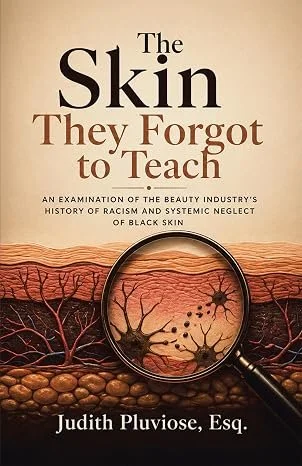
What if some of the most widely accepted ideas about Black skin were never rooted in biology to begin with?
For generations, skincare education has claimed to be universal while relying on research, language, treatment models, and educational standards that often overlooked or misunderstood melanin-rich skin.
As a result, countless professionals entered the industry believing they had been taught the science of skin — when, in reality, many had only been taught a limited perspective.
The Skin They Forgot to Teach invites readers to pause, question long-standing assumptions, and examine how history, race, science, and education became intertwined in modern esthetics.
This is not a book about assigning blame. It is a book about asking better questions.
INSIDE THE BOOK
The Questions We Were Never
Encouraged to Ask
Through historical analysis, scientific research, and professional reflection, Judith Pluviose explores how the beauty industry arrived at its current understanding of Black skin — and why many of those ideas deserve closer examination.
Rather than presenting melanin as a problem to suppress or manage, this work explores melanin as a sophisticated biological system — one that deserves the same scientific curiosity, respect, and clinical attention afforded to every other aspect of human physiology.
- 01The historical development of beauty education and its impact on melanin-rich skin.
- 02How race influenced skincare research, product development, and professional training.
- 03Common assumptions that continue to shape treatment decisions today.
- 04The biology of melanin beyond skin color alone.
- 05Why evidence-based, inclusive education matters for the future of esthetics.
WHO SHOULD READ THIS BOOK
Whether you are a licensed esthetician, dermatologist, skincare professional, educator, student, healthcare provider, researcher, or simply someone curious about the intersection of science, history, and beauty — this book offers a thoughtful examination of questions that have too often remained unasked.
THE BOOK'S STRUCTURE
Lays out the problem — how curricula, professionalism codes, and diagnostic models have historically excluded melanin-rich skin, and what that's cost patients and practitioners.
Anchoring Repair — shifts from critique to framework: what a behavior-based approach to melanin-rich skin can actually look like in practice, starting with MélanoMatrix-D™.
ANSWERED BY THE AUTHOR
Frequently Asked Questions
Judith Pluviose, Esq. answers the questions readers ask most.
It started with a single line in a licensing-exam textbook, describing dark skin as a "problematic case" for hyperpigmentation. I remember reading that and realizing the lesson wasn't really about skin; it was about erasure. That moment sent me looking for every other place the same pattern showed up: in curricula, in licensing standards, in the language we use for "professionalism," in how diagnoses get made. This book is what I found, and what I think we do about it.
Practitioners who know that some bodies are judged before they are understood. Students who feel invisible when the curriculum leaves them out. And honestly, anyone who has ever sat in a classroom or an exam room and sensed that something wasn't being said out loud.
You don't need a background in esthetics to read this; you just need to have wondered, at some point, why certain skin was treated as the standard and other skin was treated as the exception.
No. Estheticians and dermatology-adjacent practitioners will recognize the most as they read, but the book is written for a wider audience — anyone curious about how bias gets built into systems that present themselves as neutral, and anyone who wants a concrete, well-documented example of what that looks like in practice.
If you've ever wanted a close-up look at how "professional standards" can quietly encode assumptions about who belongs, this book gives you one.
MélanoMatrix-D™ is the behavior-based skin assessment and treatment-planning system introduced in the second half of the book. It expands skin assessment beyond visible appearance by examining how the skin functions and responds through Melanin Density, Reactivity, Barrier Behavior, UV Legacy, and Pigment Memory.
Two people may appear similar on the surface while demonstrating very different inflammatory responses, barrier resilience, pigment retention, and treatment tolerance. MélanoMatrix-D™ was developed to help practitioners recognize those differences and make more individualized, biologically informed decisions.
It is presented as an evidence-informed, evolving framework that should continue to be tested, studied, questioned, and refined — not treated as a finished or unquestionable answer.
Because I wanted the book to say plainly what it's about rather than soften its message for comfort. Racism and systemic neglect are strong words, and I use them intentionally — not to accuse individual practitioners of acting with malice, but to describe patterns that have been built into skincare education, research priorities, product development, and licensing standards over many decades.
The subtitle tells readers exactly what they're about to encounter. I'd rather be direct on the cover than choose a gentler title that obscures the book's central argument. If we're going to have an honest conversation about why melanin-rich skin continues to be underserved, we first have to be willing to name the systems that contributed to that reality.
Not at all. Questioning whether a textbook is complete is not the same as rejecting the value of formal education. I say this directly in the book. What I'm pushing back on is the idea that any single curriculum, developed within a particular historical context and around a particular reference population, should be treated as finished.
The ask throughout the book is for more rigor and more precision, not less science.
Because that's how I actually came to understand this subject, and I wanted readers to arrive at the same understanding the way I did — not just handed a conclusion, but shown the path to it.
The personal moments (a textbook passage, a client's skin, a story from my own family) are what made the research urgent to me. The research is what confirmed the personal moments weren't isolated. I think the book needed both to be honest.
Book I lays out the problem — how curricula, professionalism codes, and diagnostic models have historically excluded melanin-rich skin, and what that's cost patients and practitioners.
Book II, "Anchoring Repair," is where I shift from critique to framework: what a behavior-based approach to melanin-rich skin can actually look like in practice, starting with MélanoMatrix-D™. I didn't want to leave readers with only the problem.
No. I've tried to write it so that the ideas land whether or not you've ever set foot in a treatment room. Where I bring in more technical material, I explain it as I go.
What you do need is a willingness to sit with an uncomfortable history and stay curious past the discomfort.
That melanin-rich skin was never actually the problem — the frameworks built to understand it were incomplete. And that naming a gap clearly is the first step toward closing it, whether you're a practitioner rethinking how you assess a client, or a reader simply rethinking what you were taught to accept as neutral.
Knowledge has little value if it does not change how we observe, think, or care for one another. My hope is that readers leave not simply with new information, but with new questions.
It is not as simple as agreeing or disagreeing with this book. My hope is that readers engage with it honestly and objectively, and that they are willing to examine the assumptions that have shaped esthetics education, dermatology, and our understanding of melanin-rich skin.
I welcome thoughtful and respectful critiques from anyone whose questions can move this conversation forward. Science advances through questioning, observation, and evidence — not through unquestioned agreement.
I especially hope this book reaches those who sincerely believe that race, skin color, or biological differences are no longer relevant. One of the central questions this book asks is: What experiences, assumptions, or educational frameworks shaped that belief?
Ultimately, this book is not asking readers to agree with me. It is asking them to question what they have been taught, examine the evidence with intellectual honesty, and decide whether those assumptions still deserve to guide how we educate, diagnose, and care for melanin-rich skin.
What if the science
was never complete?
Paperback also available. Digital download: $19.99
THE LARGER CONVERSATION
More Than a Book
The Skin They Forgot to Teach is the beginning of a larger conversation. It reflects a commitment to advancing evidence-based education, encouraging critical thinking, and supporting a future where melanin-rich skin is understood through biology rather than assumption.
If you've ever wondered whether the science of skincare tells the whole story, this book invites you to explore what may have been left out — and why it matters.
Because understanding skin begins with understanding its biology.
Evidence-Based Education — grounded in research, historical record, and clinical observation.
Critical Thinking — encouraging readers to question what they have accepted as standard.
Biological Understanding — treating melanin-rich skin as a system worthy of its own depth of study.
Professional Growth — a resource for practitioners, educators, and students seeking more complete knowledge.
Community — part of the larger Beautélanin® educational ecosystem, including Pro, Framework, and Protocol resources.