
When Melanin Becomes a Marketing Problem
My publisher wanted a more commercially appealing cover. I wanted a cover that reflected the truth about the book I wrote.
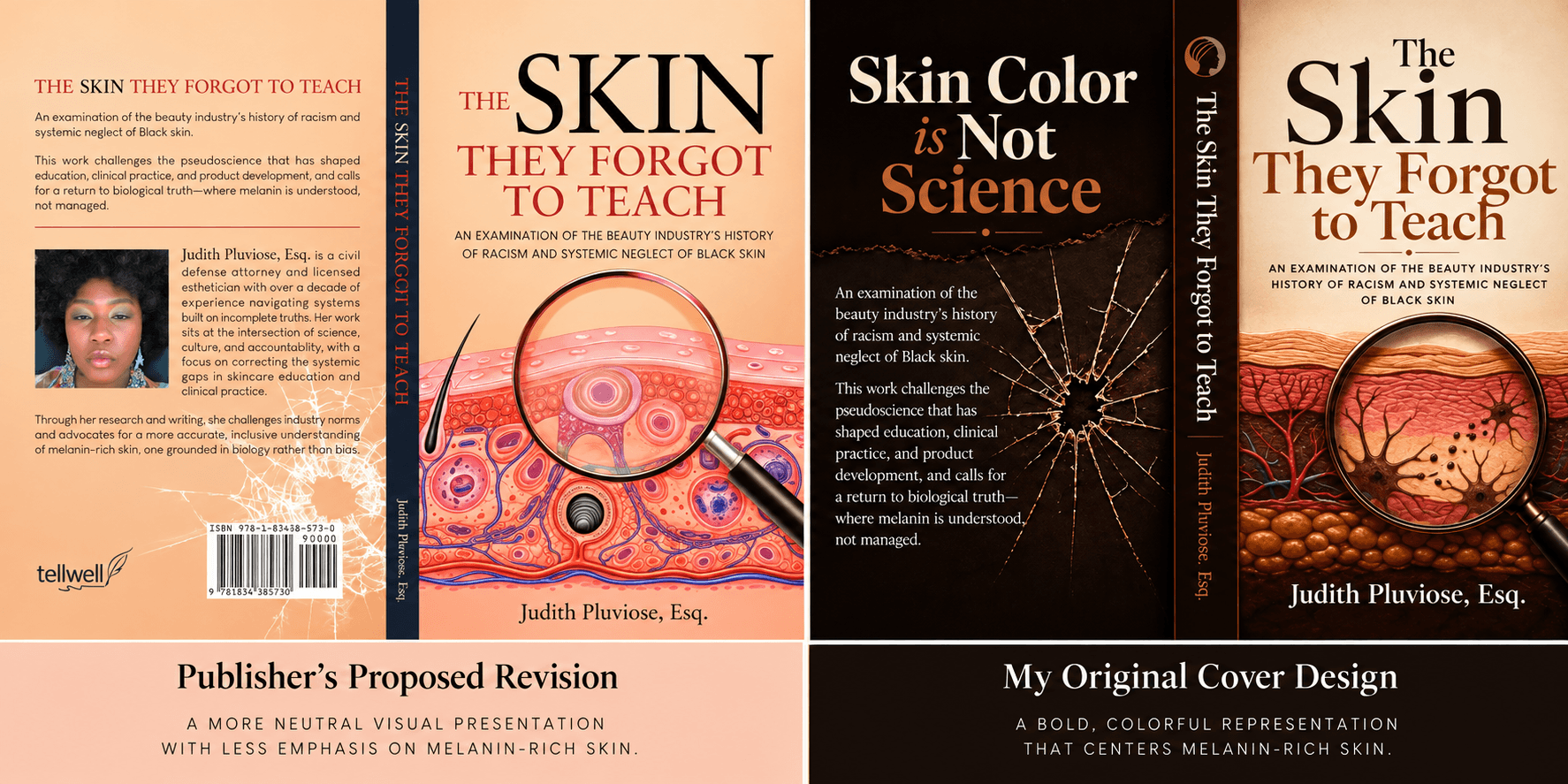
Same author. Same manuscript. Same argument. Two different visual presentations. Why was the design centering melanin-rich skin considered too subjective?
What does it mean when the author of a book about the historical neglect of Black skin is told that a cover visibly depicting melanin-rich skin may not appeal to a broader audience?
There is something profoundly unsettling about writing a book devoted to examining the historical neglect of Black skin, only to be told that the cover displaying melanin-rich skin may not be appealing enough to reach a broader audience.
That was my experience during the publishing process for The Skin They Forgot to Teach: An Examination of the Beauty Industry's History of Racism and Systemic Neglect of Black Skin.
I submitted a cover that was bold, colorful, and intentionally centered on melanin-rich skin. The illustration depicted skin anatomy in rich, warm tones. A magnifying glass invited the reader to look beneath the surface, where biology exists beyond the social meanings assigned to visible pigmentation. The typography was prominent, the colors deliberate, and the subtitle made the manuscript's purpose unmistakable.
My publisher wanted something different.
I was told that the design was too subjective and that the cover needed to be more commercially appealing to a wider audience. I understood that publishing is a business. Covers are designed to attract attention, communicate genre, and encourage readers to pick up a book. I understand that commercial considerations are part of that process.
But the explanation raised a question I couldn’t simply dismiss. What does it mean when melanin-rich skin, displayed on the cover of a book specifically about melanin-rich skin, becomes a potential obstacle to broader commercial appeal?
And who, exactly, is the broader audience we are imagining?
Appealing to Whom?
Those three words stayed with me. Appealing to whom?
Was the concern that the illustration was too colorful? Too detailed? Too unconventional for the nonfiction market? Those would have been ordinary design considerations, and I would have been willing to discuss them. But describing a cover that visibly centered Black skin as too subjective introduced a different question. Subjective compared to what?
What would an objective depiction of skin look like? Would it be lighter? Less visibly pigmented? More neutral in tone? Would a gray anatomical illustration appear more scientific? Would removing the rich pigmentation make the cover more credible, more serious, or more accessible? And if so, why?
I am not suggesting that my publisher explicitly said Black skin was undesirable. That is not what I was told, and I cannot pretend to know the motives that were never expressed. A publisher may have legitimate concerns about color balance, typography, market conventions, production quality, or retail presentation. But I can examine the implications of the recommendation I received.
When a book's subject is the historical marginalization of melanin-rich skin, and the proposed route to broader appeal involves diminishing the visual prominence of that skin, the author has every reason to question the assumptions behind that recommendation.
Why should the representation of Black skin narrow a book's perceived audience when the representation of lighter skin is so often accepted without the same question?
That is not merely a publishing question. It is a question about the visual standards we have inherited, the audiences we imagine, and the forms of humanity we have learned to recognize as universal.
The Manuscript Was Never a Generic Skincare Book
I did not write The Skin They Forgot to Teach to offer another collection of skincare tips. The manuscript examines the beauty industry's historical relationship with Black skin, the scientific assumptions that have influenced esthetics education, the limitations of racialized approaches to skin classification, and the consequences of treating melanin-rich skin as an exception within the broader study of human biology.
The Invocation and Manifesto establish that position from the beginning. The opening chapters make clear that the book examines knowledge, power, representation, and professional responsibility.
It questions how certain descriptions of skin became accepted as authoritative. It examines the ways scientific terminology has sometimes been entangled with social assumptions. It asks why professional education has not always represented the full continuum of human pigmentation with equal depth.
And it challenges practitioners to distinguish what biology actually demonstrates from what history has taught society to assume.
The manuscript is intentionally critical.
It does not pretend that the history of racial exclusion can be examined without discussing race. It does not pretend that educational omissions become insignificant because they were normalized over generations. And it does not pretend that a scientific explanation becomes objective simply because the people presenting it believe themselves to be neutral.
The book interrogates the assumptions that let one presentation of human skin become the default while another is treated as specialized knowledge.
Why, then, would I want a cover that concealed that purpose? Why should a manuscript devoted to confronting invisibility begin by making its own subject less visible?
When the Cover Begins to Reenact the Problem
The irony was difficult to ignore. My book argues that melanin-rich skin has too often been omitted, underrepresented, or treated as supplementary within professional beauty education. It examines how educational materials can establish one complexion as the primary visual reference while presenting other complexions as variations requiring additional explanation.
It challenges the practice of teaching human skin through incomplete representations and then expecting practitioners to recognize biological responses across the full pigmentation continuum. Now imagine if I had stripped the illustrations in my own book of their pigmentation in the name of broader commercial acceptance.
Imagine if the educational figures had been converted to black and white, the melanin-rich imagery removed, and the warm skin tones replaced with clinically neutral grays. The text would have argued against the marginalization of Black skin while the design diminished its presence.
The manuscript would have been asking readers to recognize what had been excluded, while the visual presentation risked repeating the same exclusion. I could not ignore that contradiction.
The illustrations in my book are not decorative additions intended to make scientific pages more attractive. They are part of the educational argument. Skin pigmentation matters because the manuscript examines the biology, representation, and treatment of melanin-rich skin.
Color is not merely an aesthetic preference when pigmentation itself is part of the subject being studied. To remove the visible presence of melanin from a book centered on melanin would not automatically make the science more objective. It could make the visual education less faithful to the subject. That was the issue I wanted my publisher to understand.
Why Does Whiteness So Often Escape the Label of Subjectivity?
A larger historical question lies beneath this experience. For generations, Western institutions have used lighter-skinned bodies as prominent visual references in medical illustrations, beauty advertisements, anatomy education, professional textbooks, and commercial imagery.
Those choices were made within particular historical and social contexts. They reflected the institutions producing the materials, the populations those institutions prioritized, the markets they served, and the assumptions they carried.
Yet repeated exposure can make a particular representation appear universal. When an image becomes familiar enough, people may stop recognizing it as a choice. It becomes the expected image. The ordinary image. The neutral image. The image that supposedly speaks to everyone. And then a darker-skinned body appears at the center of the same visual space, and suddenly the question of audience becomes more pronounced. Is this too specific? Is this too political? Will everyone relate to it? Will it sell?
Those questions deserve examination because the perceived universality of an image is not proof that the image represents everyone.
A lightly pigmented anatomical illustration still depicts a particular pigmentation phenotype. A melanin-rich anatomical illustration also depicts a particular pigmentation phenotype. Neither becomes scientifically superior by virtue of its color. Neither automatically becomes more objective. And neither can represent every aspect of human pigmentation by itself.
What matters is whether the representation fits the scientific and educational purpose. For a book examining the neglect of Black skin, an illustration that visibly depicts melanin-rich skin is not a departure from the subject. It accurately reflects that.
Melanin Is Biology, Not a Political Provocation
One of the most troubling consequences of our historical relationship with skin color is how easily biological variation can become entangled with social judgment. Melanin is a family of complex biological pigments produced through melanogenesis. It contributes to visible skin, hair, and eye pigmentation, and its properties shape how human tissues interact with light.
In skin, melanin contributes to photoprotection through mechanisms that include ultraviolet absorption and the dissipation of absorbed energy. Melanogenesis, melanosome organization, transfer to keratinocytes, and pigment distribution are all legitimate subjects of biological investigation.
These are not political inventions. They are aspects of human physiology.
Melanin-rich skin is not a separate species of skin. It is not evidence of a different category of human being. It is not inherently pathological, and its pigmentation does not make it less suitable for scientific representation.
Human pigmentation exists along a continuum shaped by inherited variation, developmental processes, population histories, and environmental influences. Yet, visible pigmentation has been assigned meanings that extend far beyond its biological function.
For centuries, skin color was used within racial classification systems that attempted to attach intellectual, moral, and social characteristics to human populations. The visible phenotype was transformed into a supposed explanation for the entire person.
Melanin biology did not establish that transformation. It was imposed upon it. The legacy of those assumptions is one reason I question what happens when the visible presence of Black skin is interpreted as making an educational work less neutral or potentially less appealing.
If the depiction of melanin-rich skin makes someone uncomfortable, we should not automatically assume the skin created the discomfort. We should be willing to examine the meanings that the observer has learned to associate with it.
That does not require accusing the observer of malicious intent. It requires intellectual curiosity. And that curiosity is central to the book.
The Difference Between a Broader Audience and an Imagined Default Audience
I want my book to reach people beyond the Black community. I want estheticians to read it. I want dermatologists, cosmetic chemists, educators, researchers, students, and professionals involved in product development to engage with its arguments. I want readers who disagree with me to examine the evidence and question my reasoning. I want the book to create conversations that continue long after the final page. As I see it, none of those ambitions requires removing Black skin from the center of the work.
A subject does not have to be visually generalized to become intellectually relevant. A book about women's health can offer important knowledge to men. A book examining disability can educate readers without disabilities. A book about Caribbean migration can illuminate questions relevant to people who have never migrated. A subject’s specificity does not determine the limits of its intellectual significance.
So why should a book about the neglect of Black skin need to become visually less Black to be considered capable of reaching a wider audience? Perhaps the more important question is whether the industry has underestimated readers’ willingness to engage with subjects outside their own immediate experience.
A reader does not need to have melanin-rich skin to understand why its representation matters. A reader does not need to be Black to recognize the consequences of incomplete scientific education. A reader does not need to be personally affected by every historical injustice to understand why examining that history is important.
A broader audience should mean inviting more people into the conversation, not making the subject less visible.
The Revised Cover Was Not the Same Argument Visually
When I compared the design I submitted with the proposed revision, I noticed how much meaning could change without altering the manuscript itself.
My design used warm, saturated tones and an anatomical illustration that clearly represented melanin-rich skin. The title and subtitle were direct. The reader could immediately identify the book's subject. The revised presentation was more restrained. Its darker neutral palette and lighter skin illustration changed the visual emphasis. On the back cover, the prominent phrase Skin Color Is Not Science introduced a broader, more abstract statement.
That phrase raises an additional concern. Skin color is absolutely a legitimate subject of scientific study. Pigmentation biology involves genetics, melanogenesis, cellular signaling, optical properties, and environmental interactions.
Science does not support the assumption that skin color determines a person's intelligence, moral character, social value, or place within a human hierarchy. Those are very different claims.
My book challenges the misuse of visible pigmentation as evidence of racial essence or human worth. It does not deny that pigmentation is biological. I wanted the cover to reflect that precision.
The original illustration invited the reader to examine skin as a biological structure. The magnifying glass was meaningful because the manuscript asks us to look beneath the visible phenotype and investigate the processes that produce it. The visual message matched the intellectual message.
I was not interested in exchanging that clarity for an abstraction that might obscure the distinction I had spent an entire manuscript trying to explain.
When Representation Is Mistaken for Bias
A peculiar misunderstanding arises whenever a historically underrepresented population is intentionally placed at the center of an educational project. Some people interpret that centering as exclusionary.
If a textbook includes more Black skin, they may ask whether the material has become too focused on race. If a professional curriculum examines pigmentary responses in melanin-rich skin, they may treat the subject as a specialty rather than a necessary part of understanding human skin.
If a book cover prominently depicts Black skin, they may wonder whether the design is too narrow for general readership.
But centering a subject is not the same as declaring that subject superior. A book examining the neglect of Black skin does not argue that lighter skin is unimportant. Similarly, a curriculum that includes more melanin-rich imagery does not diminish the scientific relevance of lightly pigmented skin.
A call for complete representation does not require replacing one exclusion with another. The goal is not to reverse the hierarchy. It is to question why the hierarchy was permitted to shape our understanding in the first place.
This distinction matters because the demand for inclusion is sometimes misunderstood as a demand for preferential treatment. It is not.
I am asking for the biology to be taught completely. I am asking for visual examples to reflect the range of human pigmentation. I am asking that professional education stop treating certain populations as though they enter the scientific conversation only when their differences require special management. And I am asking why the same expectation should not apply to the presentation of a book devoted to those very questions.
This book is not an argument for superiority. It refuses to accept erasure.
The Commercial Language of Neutrality
Words such as neutral, objective, mainstream, and commercially appealing sound practical. They can be practical. But they are not immune from scrutiny. Neutral according to which visual convention? Objective according to which reference? Mainstream according to which population? Commercially appealing according to which imagined consumer?
Market research can provide useful information about readers' preferences. Publishing professionals can offer legitimate expertise about typography, format, production, and design.
But a recommendation about commercial appeal should be examined when it would weaken the connection between a book's visual presentation and its central argument. Because commercial decisions do more than respond to markets. They also help shape what those markets repeatedly see.
Every time a publisher selects one kind of image as broadly marketable and treats another as too specific, that decision contributes to the visual environment readers encounter.
Over time, those patterns can reinforce expectations about whose stories are general and whose stories are specialized. That is why I was unwilling to treat the conversation as merely a disagreement over colors.
The colors were connected to the subject. The subject was connected to the history. And the history was precisely what I had written the book to examine.
I Did Not Write This Book to Be Comfortable
There are moments when authors must decide what they are willing to compromise. I am willing to discuss layout. I am willing to revise language when evidence demands greater accuracy. I am willing to reconsider an illustration if it misrepresents anatomy or creates scientific confusion. I am willing to accept editorial criticism that makes the work clearer, stronger, and more accessible. But I am not willing to diminish the subject of the manuscript simply because its visibility may challenge an imagined audience's expectations.
My book is not a declaration that every institution, educator, or practitioner has acted with discriminatory intent. It examines how certain bodies of knowledge can carry assumptions across generations, including assumptions individuals may reproduce without recognizing them.
That is why the questions matter. Why did a particular visual reference become standard? Why were some presentations treated as universal and others as exceptional? What did the available evidence actually establish? What interpretations were added afterward? And who benefited when those interpretations became accepted knowledge?
These are uncomfortable questions because they require us to examine the foundations of what we have learned. But discomfort does not invalidate inquiry. Sometimes it reveals where inquiry is needed.
The Cover Became Part of the Lesson
I began this publishing process believing that the cover would introduce my book. I did not anticipate that the discussion surrounding the cover would become such a direct illustration of the book's central argument.
The manuscript examines how education has marginalized melanin-rich skin. The publishing conversation raised the possibility that visually centering melanin-rich skin could limit commercial appeal.
The manuscript challenges the assumption that one pigmentation phenotype should function as the default representation of human skin. The cover discussion prompted me to ask what kind of skin imagery broad audiences perceive as sufficiently neutral.
The manuscript questions how social assumptions become embedded in professional language. The words subjective and commercially appealing required me to examine that possibility. I do not need to prove that my publisher intended to erase Black skin to recognize the significance of this experience.
The questions exist independently of anyone's intent. The side-by-side covers give readers an opportunity to examine those questions for themselves.
Same author. Same title. Same manuscript. Same historical examination. Same scientific arguments. Different visual presentations. Why should one depiction of human pigmentation require more justification than another?
That is the question I want readers to consider.
What Has Our Training Trained Us to See?
This experience returns me to one of the most important questions behind The Skin They Forgot to Teach. What has our training trained us to see?
Not simply what information have we memorized. Not simply what definitions can we repeat. But what have we learned to recognize as normal, scientific, credible, universal, and worthy of attention?
Professional training shapes observation. Publishing shapes presentation. Marketing shapes familiarity. And familiarity can and does influence what audiences come to expect.
When those expectations go unexamined, they can begin to feel like objective standards even when they reflect a much narrower history of representation. That is why I believe education must do more than add occasional images of Black skin to an otherwise unchanged curriculum.
It must examine the assumptions that determined which images were considered foundational in the first place. The same principle applies to publishing.
It is not enough to say that a book about Black skin can exist, provided its visual presentation is sufficiently neutralized for broader consumption. The subject should not have to disappear to earn attention.
The Skin They Forgot to Teach Was Never About Being Centered Above Others
I kept my book focused where it belonged. On melanin-rich skin. On the scientific questions that deserve more careful examination. On the historical assumptions that deserve to be challenged. On the educational omissions that deserve correction. Finally, on the humanity that should never have been reduced to a racial category masquerading as biological explanation.
I did not choose the original cover because I believed Black skin was superior. I chose it because Black skin was the subject.
I did not insist upon rich pigmentation because I wanted to exclude anyone. I insisted on it because the manuscript examined what happens when that pigmentation is repeatedly excluded, minimized, or misrepresented.
I did not reject the suggestion of a more commercially appealing design because I oppose commercial success. I questioned whether commercial success should require weakening the very argument readers were being invited to consider.
There is a difference. And that difference matters.
Black skin does not require a separate human biology. It requires complete representation within the biology already being taught.
A book about that principle should not have to begin by compromising it. I want my book to reach a broad audience. I want people of every complexion to read it.
I want them to examine the evidence, challenge my conclusions where necessary, and ask their own questions. But I will not assume that readers need Black skin to become less visible before they can engage with a serious discussion about it.
The cover of The Skin They Forgot to Teach was never intended to tell readers that Black skin mattered more than anyone else's. It was intended to make clear that Black skin matters within the same human biology we all share.
And after writing an entire book challenging its historical marginalization, I wasn’t about to let its disappearance become the first lesson readers encountered.
The Skin They Forgot to Teach was never about being centered above others. It was about no longer being omitted from the lesson.
And if the visible presence of melanin-rich skin on the cover of a book about melanin-rich skin is considered too subjective for a broader audience, perhaps the problem is not the cover.
Perhaps we need to examine what we have been taught a broader audience is supposed to look like.
Judith Pluviose, Esq., is the author of The Skin They Forgot to Teach and founder of Beautélanin® Skincare. Her work examines the intersection of skin biology, professional esthetics education, historical representation, and the assumptions that shape how people understand human pigmentation.
Get Your Copy of The Skin They Forgot to Teach
Beautélanin™ articles are for education only and do not replace medical advice.
