
Understanding Pigmentation Through Biology, Not Just Appearance
How the MRBUP® Behavior Assessment Framework Shifts Clinical Observation from Surface Findings to the Biological Behaviors That Shape Melanin-Rich Skin
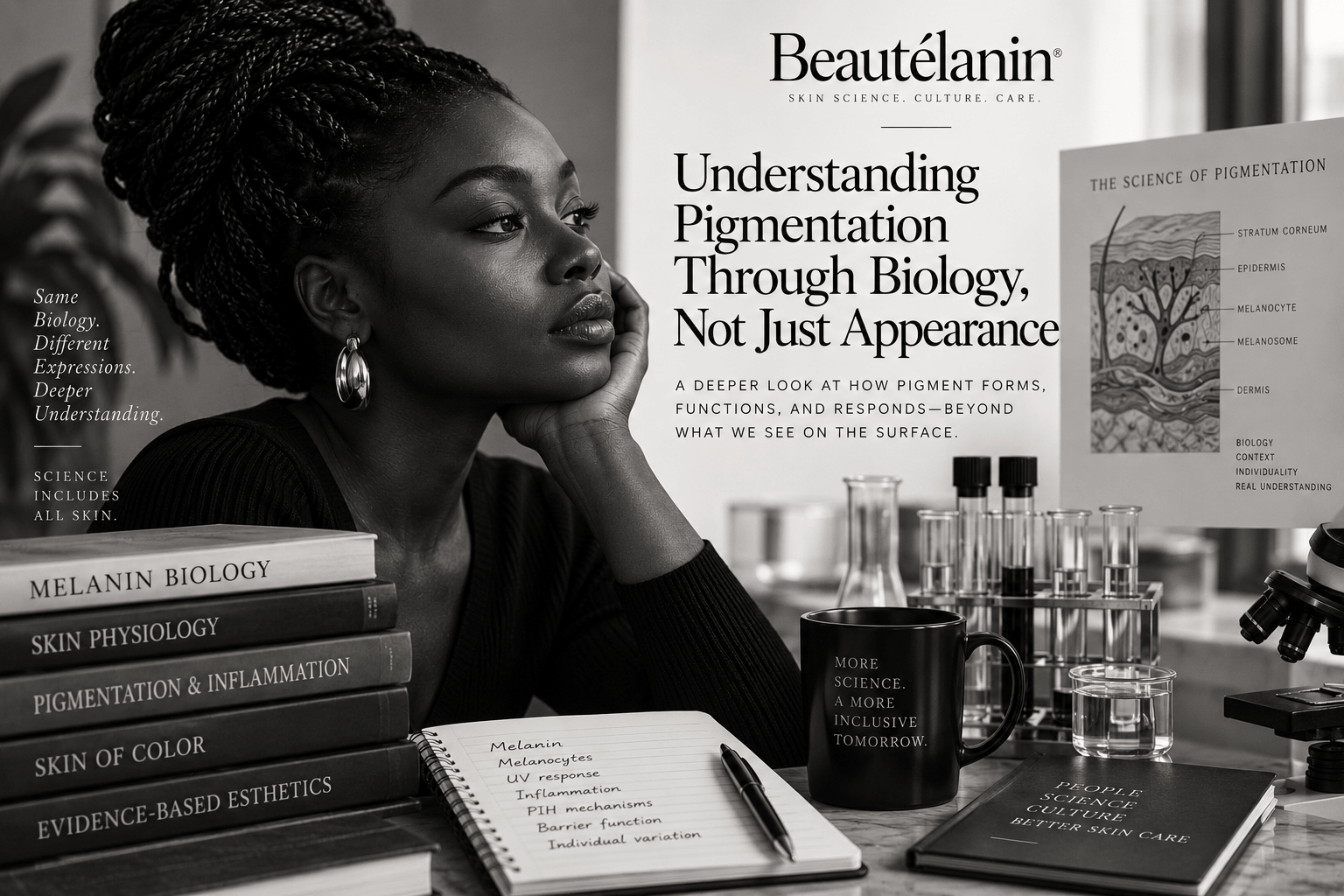
Understanding Pigmentation Through Biology in Melanin-Rich Skin | Beautélanin®
MRBUP® — A Different Way of Reading the Skin
For decades, pigmentation has been evaluated mainly by appearance: color, depth, distribution, and location. Yet skin rarely behaves according to appearance alone. The same visible discoloration may arise from entirely different biological pathways, each shaped by inflammation, barrier function, ultraviolet exposure, and the skin's remarkable capacity to adapt and remember. This article introduces the MRBUP® Behavior Assessment Framework, a behavior-based approach that encourages practitioners to move beyond surface observation and toward understanding the biological conversations that produce pigment. The framework does not ask "What does this discoloration look like?" MRBUP® asks a different question: "What is the skin responding to?" That shift transforms pigmentation from a cosmetic concern into a story of physiology, adaptation, and clinical reasoning.
There is a quiet assumption that has shaped much of modern skincare: that what we see is the story. We are taught to examine the dark spot, the wrinkle, the enlarged follicle, the patch of dryness, or the uneven tone as though the visible change were the beginning of the conversation. Entire treatment protocols are often built around correcting what appears before our eyes. Yet the skin has never promised that its surface would tell the whole truth.
What if the visible change is not the beginning of the story at all? What if it is the final sentence in a chapter that began weeks, months, or even years before we first noticed it?
A wrinkle does not appear because the skin suddenly forgot how to produce collagen. Hyperpigmentation is not born in the instant we see it reflected in a mirror. Even a compromised barrier is rarely the consequence of a single cleanser or one unfortunate afternoon in the sun. The skin is not impulsive. It is adaptive. Every visible change is the result of countless biological conversations unfolding beneath the surface, long before the eye can perceive them.
Perhaps that is where our greatest misunderstanding begins.
For generations, we have become remarkably skilled at describing the appearance of skin. We have developed elaborate vocabularies for classifying lesions, grading acne, measuring wrinkles, and identifying pigmentation. Yet description alone is not understanding. To describe what we see is only the first step. The more meaningful question is why the skin chose that particular response in the first place.
This question became the foundation upon which the MRBUP® Framework was built.
Not as a diagnostic tool. Not as a replacement for medical evaluation. But as an educational framework that encourages practitioners to pause before reaching for a product, a peel, or a protocol. It asks us to become students of behavior rather than critics of appearance.
The letter M reminds us that melanin is not simply pigment. It is one of the body's remarkable adaptive systems, refined over generations to help protect living tissue from ultraviolet radiation and environmental stress. To understand melanin is to appreciate that pigmentation often represents biology at work rather than biology gone wrong.
The letter R invites us to think beyond the presence or absence of inflammation. Skin rarely reacts without purpose. Whether the response is immediate or delayed, visible or nearly invisible, reactivity reflects communication between cells that are continually responding to injury, microbes, hormones, ultraviolet radiation, emotional stress, and countless environmental influences. Inflammation is not merely something to suppress; it is something to understand.
The B asks us to consider the barrier, not as a wall that occasionally breaks, but as a living interface between the body and the world. Every day it negotiates what should remain inside, what should be kept outside, and how to preserve equilibrium in an environment that is constantly changing. When the barrier becomes compromised, it is often responding to cumulative demands rather than isolated mistakes.
The U reminds us that the skin remembers sunlight long after the warmth has faded. Ultraviolet exposure is rarely a single event; it is a history written slowly across decades. The skin carries that history quietly, revealing it only when cumulative changes eventually become visible. What we observe today may reflect environmental experiences from many years ago.
Finally, P asks us to respect one of the skin's most extraordinary qualities: its memory. Living tissue remembers inflammation, injury, hormonal fluctuations, environmental stress, and healing. Particularly in melanin-rich skin, pigment often becomes part of that memory, preserving evidence of events long after the original insult has resolved. The skin does not remember because it refuses to heal. It remembers because memory itself is one of the ways the body protects its future.
Taken together, these five domains invite us to replace certainty with curiosity. Instead of asking, "How do I remove this?" we begin asking, "What biological process brought us here?" Instead of judging the skin by its appearance, we begin listening for the story hidden beneath its behavior.
Perhaps this is the quiet revolution that esthetics has been waiting for. Not another ingredient. Not another device. Not another promise of perfection. But a different way of seeing.
Because the skin has never asked us to admire its perfection. It has only asked us to understand its remarkable capacity to adapt, to protect, to communicate, and to remember.
When we begin there, treatment becomes more thoughtful. Education becomes more meaningful. And compassion naturally follows.
For the skin has never been our opponent.
It has always been our teacher.
Beautélanin™ articles are for education only and do not replace medical advice.
