
Clinically Tested—But Clinically Tested on Whom?
Why Representation Matters When We Talk About Safety, Efficacy, and Melanin-Rich Skin
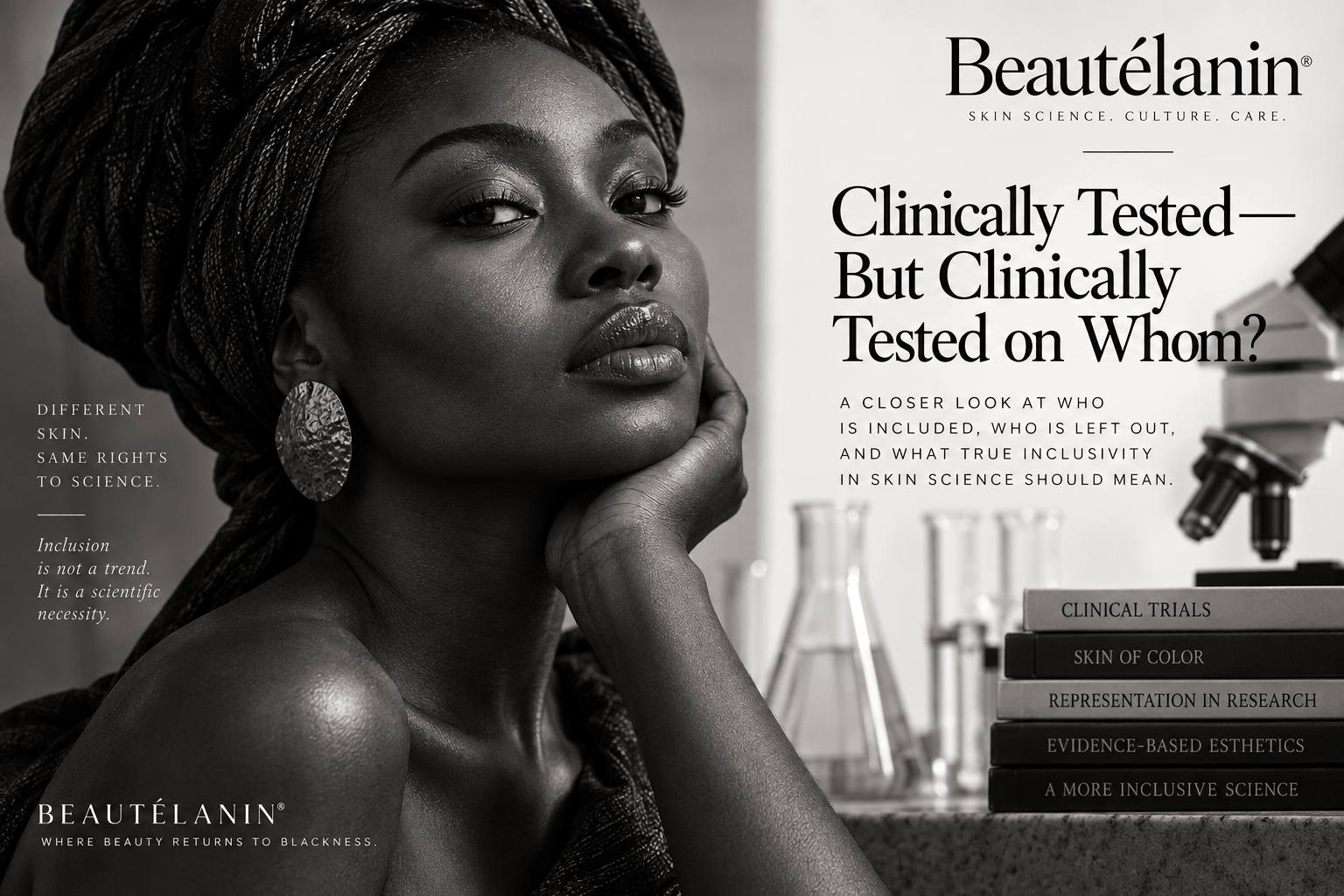
Clinically Tested on Whom? | Melanin-Rich Skin Representation in Clinical Research | Beautélanin®
There are certain phrases in skincare that have become so familiar that we rarely stop to examine them.
Dermatologist tested.
Clinically proven.
Clinically tested.
Suitable for all skin types.
They appear on packaging, advertisements, websites, and product descriptions, quietly reassuring us that someone, somewhere, has already asked the important questions about safety and efficacy.
But whenever I see the words clinically tested, another question immediately follows: Clinically tested on whom?
That question is not an accusation against clinical research. Quite the opposite. It reflects respect for what clinical research is supposed to do.
A study can only tell us about the population that was actually studied, under the conditions in which the study was conducted, using the outcomes researchers chose to measure.
If the participants are not adequately described, if darker skin tones are poorly represented, or if pigmentary consequences are not among the outcomes being monitored, then the phrase clinically tested may tell us considerably less than we think it does. And for melanin-rich skin, those missing details matter immensely.
Clinical Evidence Is Only as Representative as the People Included
Underrepresentation of skin of color in dermatologic and cosmetic research is not merely a Beautélanin® observation. It has been documented in the scientific literature.
A review of cosmetic randomized controlled trials found poor racial and ethnic representation among skin-of-color participants, with industry sponsorship associated with lower participant diversity. More recent research examining cosmetic dermatology literature from 2018 through 2023 reached a similar conclusion: skin of color remained significantly underrepresented, and even studies focused on skin of color were disproportionately concentrated among certain phototypes and ethnic populations.
Another analysis examining ClinicalTrials.gov data from 2008 through 2022 found substantial gaps in representation across dermatologic conditions affecting skin-of-color populations.
This means we should be careful about what we infer from the phrase clinically tested. It does not automatically mean that every complexion was represented. It does not automatically mean that every relevant adverse response was measured.
And it certainly does not mean that the results can be assumed to apply identically to every person who eventually purchases the product. The problem is not clinical testing. The problem is assuming universality without examining representation.
Safety Is More Than "Did Irritation Occur?"
This becomes particularly important when we consider melanin-rich skin. A study may monitor burning, stinging, erythema, dryness, or peeling and conclude that a product was well tolerated. Those are meaningful outcomes.
But were pigmentary changes monitored? Was delayed post-inflammatory hyperpigmentation assessed? How long were participants followed? Were Fitzpatrick IV, V, and VI skin types adequately represented?
Were objective measurements supplemented by clinical observations appropriate for darker skin? Did investigators consider that erythema may be less visually obvious in deeply pigmented skin? These questions do not invalidate the study.They tell us how much we can reasonably conclude from it.
At Beautélanin®, this distinction is fundamental because absence of a measured adverse event is not necessarily evidence that every biologically relevant response was evaluated.
If pigmentation was never an outcome, the study cannot tell us very much about pigmentation. If darker phototypes were not adequately represented, we should be cautious about assuming identical responses in those populations. That is not distrust of science. That is how science is supposed to be read.
What Inclusive Skin Research Can Look Like
We are beginning to see studies designed more intentionally around pigmentary behavior in darker phototypes.
For example, a recent randomized study evaluating prevention of post-inflammatory hyperpigmentation specifically enrolled participants with Fitzpatrick skin types IV-V. Researchers deliberately created conditions involving ultraviolet and visible-light exposure, with and without barrier disruption, and measured pigmentation and erythema using both clinical assessment and instrumental colorimetry. Participants were followed over 20 days, and pigmentation itself was a central outcome rather than an incidental observation.
That distinction matters. The researchers were not merely asking: Does this product irritate the skin?
They were asking questions relevant to the behavior of the population being studied. What happens to pigment after inflammation? What happens when barrier disruption and light exposure occur together? Can the resulting pigmentation be measured objectively?
That is the kind of specificity we should want from research. Not because every study must focus exclusively on melanin-rich skin, but because claims about broad applicability become stronger when the research population actually reflects that breadth.
Seven Questions I Ask When I Read a Skincare Study
1. Who Was Actually Studied?
Before I become impressed by the conclusion, I want to understand the participants. How many people were enrolled?What were their ages?What Fitzpatrick phototypes were represented? Were race and ethnicity reported?Where was the study conducted? Were participants recruited from one geographic region?
A statement such as ethnically diverse is considerably less useful than actual demographic information. Diversity should be something we can examine, not something we are simply asked to assume.
2. Were Darker Phototypes Adequately Represented?
The absence of Fitzpatrick information does not prove that darker-skinned participants were excluded. But it prevents us from knowing. That distinction is important.
When a product makes broad claims about suitability, I want to know whether the study included enough variation in pigmentation to support those claims.
The Fitzpatrick system itself has limitations and should never be mistaken for a complete description of skin biology. Nevertheless, phototype information can provide useful context when evaluating studies involving ultraviolet response, pigmentation, lasers, peels, and other procedures in which melanin behavior matters.
3. What Outcomes Were Researchers Looking For?
This may be one of the most important questions. Researchers find what they design studies to measure.
If a trial evaluates wrinkles, hydration, and elasticity but never evaluates pigmentation, it cannot meaningfully answer questions about pigmentary response.
If irritation is evaluated only through visible erythema, we should consider whether that measurement adequately captures inflammatory responses across all complexions.
For melanin-rich skin, I want to know whether researchers considered outcomes such as persistent pigment alteration, post-inflammatory hyperpigmentation, delayed inflammatory response, barrier disruption, and recovery time when those outcomes are biologically relevant to the intervention being tested.
4. How Long Did the Study Last?
Skin does not always respond immediately. This is particularly important when considering the Beautélanin® concept of Pigment Memory.
A client may tolerate a treatment beautifully on the day it is performed and develop pigmentation days later. Barrier disruption may become apparent after repeated use rather than after a single application. Cumulative irritation may take weeks to reveal itself.
A short-term study can answer short-term questions. It cannot automatically answer long-term ones. When reading research, we should therefore ask not simply whether adverse events occurred, but when researchers stopped looking for them.
5. Was the Formulation Studied or Merely the Ingredient?
This distinction gets lost constantly in skincare conversations. An ingredient is not a finished product. Concentration matters. pH matters. Delivery system matters. Vehicle matters. Ingredient interactions matter. Frequency of use matters. Application amount matters.
A study showing benefit from one concentration of an ingredient in a particular formulation does not automatically validate every product containing that ingredient. This is particularly important when discussing exfoliating acids, retinoids, vitamin C systems, enzymes, and newer cosmetic technologies.
The better question is not simply: "Has this ingredient been clinically studied?"
It is: "How closely does the evidence resemble the formulation, concentration, delivery system, population, and conditions in which I intend to use it?"
6. What Does "Suitable for All Skin Types" Actually Mean?
This phrase deserves curiosity. When I see it, I want to know what evidence supports the word all. Was the product tested across multiple phototypes? Were different barrier presentations represented? Were participants with varying levels of sebaceous activity included? Were pigmentary outcomes evaluated when relevant? Were there enough participants in each group to observe meaningful differences?
"Universal" is a very large scientific claim. The evidence supporting it should be equally thoughtful.
7. Who Funded the Research, and Can I Read It?
Industry-funded research is not automatically poor research. That would be an unfair conclusion. Cosmetic companies frequently fund research because developing and testing products requires resources. But funding sources, investigator relationships, study design, methodology, conflicts of interest, and publication status all help us understand the evidence we are reading. Rather than automatically accepting or rejecting industry research, I prefer another approach:
Read the methodology.
Who funded it?
Who designed it?
Was there a control?
Was it randomized?
Was it blinded where appropriate?
How large was the sample?
What outcomes were predetermined?
Were adverse events reported?
Can the complete study be examined, or are we reading only a marketing summary? These questions do not make us cynical. They make us informed.
The Ingredients Are Not the Villains Either
I also want to be careful about how we discuss ingredients such as alpha hydroxy acids, beta hydroxy acids, retinoids, enzymes, and vitamin C. These ingredients are not inherently inappropriate for melanin-rich skin. The concern is context.
Concentration, frequency, formulation, barrier status, treatment intensity, inflammatory history, concurrent products, environmental exposure, and individual skin behavior all influence tolerability.
For someone whose skin develops persistent pigmentation following relatively minor inflammation, provoking unnecessary irritation may have consequences that extend beyond temporary redness or discomfort.
That is why the question should not be: "Is glycolic acid safe for Black skin?"
The better questions are: At what concentration? At what pH? How frequently? On what barrier? For which concern? With what inflammatory history? And how does this particular person's skin behave after challenge? That is a very different way of thinking.
This Is Where MRBUP® Enters the Conversation
Within the Beautélanin® Clinical Skin Behavior Assessment Methodology, we do not assume that a product described as clinically tested will behave identically on every client.
We return to the skin.
Through the MRBUP® Framework, we consider Melanin Density, Reactivity, Barrier Behavior, UV Legacy, and Pigment Memory alongside the client's history, contextual factors, physical observations, and previous responses.
A published study is evidence. The client's history is also evidence. The condition of the barrier is evidence. Previous reactions are evidence.
Patterns are evidence.
And when those pieces of evidence do not agree, we do not force them into agreement simply because a product carries an impressive claim.We investigate the conflict. That is the difference between rejecting clinical research and reasoning with clinical research.
Beautélanin® chooses the latter.
What I Want "Clinically Tested" to Mean
I do not want fewer clinical studies.
I want better ones.
I want studies that describe their participants clearly enough for practitioners and consumers to understand who was represented.
I want pigmentary outcomes considered when the intervention makes them relevant.
I want darker phototypes intentionally included rather than treated as an optional subgroup.
I want adverse responses followed long enough to capture delayed effects.
I want researchers to tell us when the evidence is limited rather than allowing marketing language to make the conclusion larger than the study.
And I want consumers—especially Black and Brown consumers—to understand that asking these questions does not make them difficult.
It makes them informed participants in their own skincare.
Because perhaps the most important question printed on a bottle is not:
"Was this clinically tested?"
Perhaps it is the question that should immediately follow: "Were people whose skin behaves like mine part of the evidence?"
That is not a rejection of science.
It is a request to be included in it.
Beautélanin® Principle: Clinical evidence should never ask us to assume representation. Good evidence gives us enough information to examine it.
Beautélanin™ articles are for education only and do not replace medical advice.
