
Skin Cancer, Melanin, and the Cost of Being Overlooked
Why Observation Matters More Than Assumptions
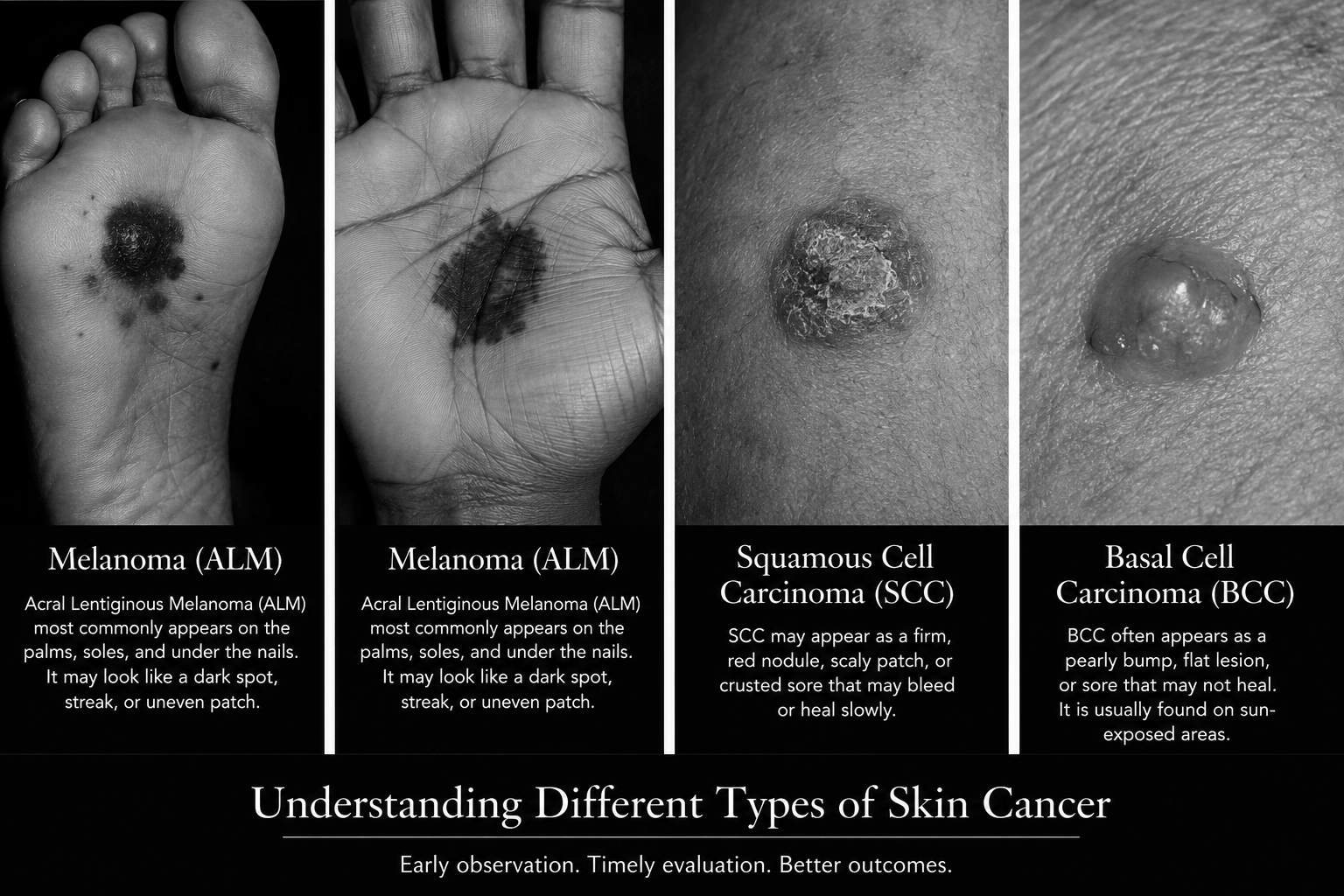
Black-and-white editorial collage comparing melanoma, acral lentiginous melanoma (ALM), squamous cell carcinoma (SCC), and basal cell carcinoma (BCC) to promote skin cancer awareness in melanin-rich skin.
For decades, one of the most persistent myths in dermatology has been that people with melanin-rich skindo not get skin cancer. Although this belief has never been scientifically accurate, it became deeply embedded in public health messaging, clinical education, textbook imagery, and even patient perception. As a result, generations of individuals with melanin-rich skin were taught, either directly or indirectly, that melanoma was largely someone else's concern.
The consequences of that misconception continue to be felt today.
According to the American Academy of Dermatology, White individuals are approximately thirty (30) times more likely to be diagnosed with melanoma than individuals with melanin-rich skin At first glance, that statistic appears reassuring. However, incidence tells only part of the story. Melanin-rich skin patients consistently experience the lowest five-year survival rate for melanoma, not because melanin makes skin cancer more aggressive, but because the disease is frequently recognized much later, when treatment options become more limited and outcomes become less favorable.
This distinction matters because developing a disease less frequently is not the same as surviving it more often.
Melanin Was Never the Problem
One of the unfortunate consequences of these statistics is that melanin itself is often portrayed as though it somehow complicates diagnosis or interferes with proper medical care. In reality, melanin is one of the body's most sophisticated biological defense systems. It absorbs ultraviolet radiation, reduces oxidative stress, helps protect DNA from damage, and preserves essential nutrients such as folate. From an evolutionary perspective, melanin represents adaptation rather than deficiency.
Melanin does not make an individual immune to skin cancer. Nor does it make melanoma inherently more aggressive. The greater challenge lies elsewhere. Too often, the healthcare system has been taught to recognize disease most confidently when it appears on lighter skin.
What We Teach Reflects What We Prioritize
Every educational curriculum reflects priorities. Medical textbooks decide which photographs deserve inclusion. Licensing examinations determine which concepts students must memorize. Public health campaigns choose whose skin appears in educational materials. These decisions shape generations of practitioners long before they ever examine their first patient.
One observation that has remained with me throughout my legal and esthetics education concerns the stratum lucidum. This translucent epidermal layer exists only within the thick skin of the palms of the hands and soles of the feet. In many esthetics classrooms it receives only brief mention. Students memorize its location, answer a question or two, and move on. It receives comparatively little attention within licensing examinations despite representing anatomically important regions of the body.
That observation becomes particularly meaningful when considered alongside acral lentiginous melanoma (ALM), the subtype of melanoma most commonly diagnosed in patients with melanin-rich skin. Unlike many melanomas associated with chronic ultraviolet exposure, ALM frequently develops on the palms, soles, and beneath the nails.
I am not suggesting that the presence of the stratum lucidum causes melanoma. Nor am I suggesting that educators intentionally ignore this anatomy. My point is different.
Educational emphasis often reflects historical priorities. When certain diseases predominantly affect populations of European ancestry, they naturally receive greater research attention, more textbook pages, more clinical photographs, and more classroom discussion. Conditions that disproportionately affect melanin-rich populations have too often occupied the margins of medical education.
The stratum lucidum simply illustrates this broader pattern.
The Cost of Educational Blind Spots
When practitioners are trained using predominantly lighter skin imagery, confidence naturally develops around recognizing disease in lighter skin. When melanin-rich skin is underrepresented in research, textbooks, and clinical photography, uncertainty follows. When patients rarely see themselves represented in skin cancer awareness campaigns, they may never imagine that a suspicious lesion deserves evaluation.
None of these gaps exist because melanin hides disease. They exist because our educational systems have not always taught practitioners to look for disease with equal confidence across the full spectrum of human skin. The result is delayed recognition. Delayed diagnosis. And ultimately, poorer outcomes.
Observation Is Where Change Begins
Recognizing these educational gaps raises an important question. How do we train ourselves to observe differently?
At Beautélanin®, this question ultimately led to the development of the MRBUP® Framework, a federally registered educational framework designed to encourage systematic observation rather than assumption.
Rather than relying solely on generalized skin typing or isolated concerns, MRBUP® encourages practitioners to evaluate skin through five interconnected domains:
Melanin Density
Reactivity and Inflammatory Response
Barrier Behavior and Resilience
UV Legacy and Pigment Activation
Pigment Memory and Pigment Mapping
The framework does not diagnose disease. It does not replace dermatologists. It does not substitute for biopsy or pathology. Its purpose is far simpler. It teaches practitioners how to observe intentionally.
Melanin Density (M): Begin by thoughtfully assessing the client's skin tone and understanding how different levels of pigmentation may influence the appearance of erythema, inflammation, bruising, or lesions. This awareness helps practitioners avoid overlooking subtle changes that appear differently on melanin-rich skin.
Reactivity and Inflammatory Response (R): Observe the client's response to minor injury, irritation, or inflammation. Take note of areas that remain persistently inflamed or heal abnormally, and document any skin behaviors that seem unexpected. This encourages proactive dialogue and timely referral when necessary.
Barrier Behavior and Resilience (B): Examine the overall health of the skin's protective barrier. Note any regions with compromised function, abnormal sensitivity, or delayed healing. Healthy skin barriers support overall well-being, but never assume that healthy-appearing skin cannot hide important changes.
UV Legacy and Pigment Activation (U): Explore the client's history of sun exposure, including past occupations, travel, and habits related to sun protection. Understand that cumulative sun damage may not always be obvious, especially in darker skin tones, and stay curious about subtle changes over time.
Pigment Memory and Pigment Mapping (P): Observe and record patterns of pigment change, both short- and long-term. Regularly track any evolving pigmentation, asymmetry, or lesions that do not resolve. When in doubt, encourage clients to seek evaluation from a medical professional.
By mindfully applying each axis of the MRBUP® Framework, estheticians can strengthen their ability to notice patterns, ask relevant questions, and support their clients through informed observation, ultimately leading to better skin health for all.Observation Is an Ethical Responsibility
Estheticians are not physicians.
We do not diagnose melanoma.
We do not tell clients whether a lesion is cancerous.
Our responsibility is different.
We observe.
We document.
We compare.
We ask thoughtful questions.
And when something appears inconsistent with the client's normal presentation, we encourage timely medical evaluation. Perhaps the greatest contribution an esthetician can make is not identifying melanoma. It is recognizing that something deserves another look.
Conclusion
Perhaps the greatest lesson from melanoma disparities is not that individuals with melanin-rich skin can develop skin cancer, we have known that for decades. The greater lesson is that equitable healthcare begins with equitable observation.
When education excludes certain populations, practitioners inherit those blind spots unless they intentionally seek broader knowledge. Every client deserves to be seen through careful observation rather than assumption.
At Beautélanin®, that belief inspired the creation of the MRBUP® Framework. Not because one framework can eliminate disparities. But because meaningful change begins the moment we choose to look more carefully than we have before.
References
(2023). Melanoma of the Skin — Cancer Stat Facts. SEER Cancer Statistics. https://seer.cancer.gov/statfacts/html/melan.html
Fernandez, J. M., Poling, K. L., Desai, A. D., Koblinski, J. E., Borgstrom, M., Abraham, I. & Behbahani, S. (2023). Primary cutaneous melanoma in Black patients: An analysis of 2464 cases from the National Cancer Database 2004-2018. Pigment Cell & Melanoma Research 36(1), pp. 42-52. https://doi.org/10.1111/pcmr.13065
Huselton, C. A. & Hill, H. Z. (1990). Melanin photosensitizes ultraviolet light (UVC) DNA damage in pigmented cells. Environmental and Molecular Mutagenesis 16(1), pp. 37-43. https://doi.org/10.1002/em.2850160107
Hoekstra, H. E. (2006). Genetics, development and evolution of adaptive pigmentation in vertebrates. Heredity 97. https://doi.org/10.1038/sj.hdy.6800861
Alvarado & Feng. (2020). Analysis of skin color in the American Academy of Dermatology basic dermatology curriculum. Journal of the American Academy of Dermatology 82(1), pp. 1-3. https://doi.org/10.1016/j.jaad.2019.07.062
Lunsford, N. B., Berktold, J., Holman, D. M., Stein, K., Prempeh, A. & Yerkes, A. (2018). Skin cancer knowledge, awareness, beliefs and preventive behaviors among black and hispanic men and women. Preventive Medicine Reports 12. https://doi.org/10.1016/j.pmedr.2018.09.017
Midani, L., Ridgeway, G., Phillips, C. M. & Smidt, A. C. (2024). Inclusive Dermatology — Creating a Diverse Visual Atlas of Skin Conditions. New England Journal of Medicine 390(22), pp. 2037-2038. https://doi.org/10.1056/NEJMp2313807
Brenner, M. & Hearing, V. J. (2008). The Protective Role of Melanin Against UV Damage in Human Skin. Photochem Photobiol 84(3), pp. 539-549. https://doi.org/10.1111/j.1751-1097.2007.00226.x
Beautélanin™ articles are for education only and do not replace medical advice.
