
From Awareness to Action: Why We Developed the MRBUP® Framework
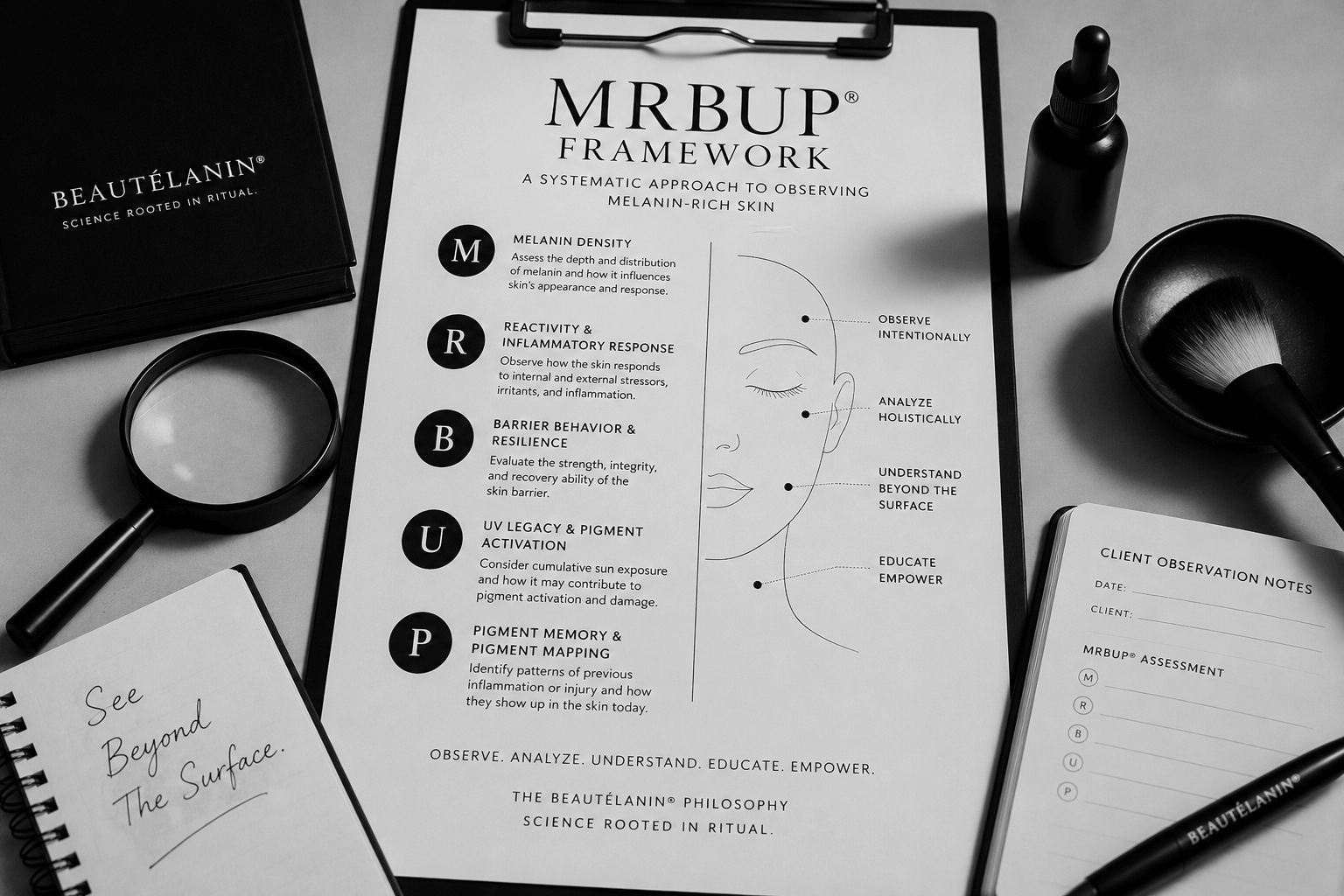
Black-and-white editorial illustration of the MRBUP® Framework showing the five observation domains used to systematically assess melanin-rich skin.
Recognizing disparities in melanoma outcomes is only the first step. The more important question is what practitioners can do differently in their daily practice. At Beautélanin®, we believe improving outcomes begins with improving observation. While estheticians do not diagnose skin cancer, they often spend significant time examining the skin under magnification, documenting changes over time, and developing long-term relationships with their clients. This places them in a unique position to notice patterns that deserve further evaluation.
It was this philosophy that led to the development of the MRBUP® Framework, a federally registered educational framework designed to encourage systematic, behavior-based observation of the skin. Rather than relying solely on skin type classifications or isolated concerns, MRBUP® invites practitioners to evaluate the skin through five interconnected domains: Melanin Density, Reactivity and Inflammatory Response, Barrier Behavior and Resilience, UV Legacy and Pigment Activation, and Pigment Memory and Pigment Mapping.
The framework is not intended to diagnose disease or replace medical evaluation. Instead, it provides a structured method for observing the skin more intentionally, recognizing meaningful changes, documenting findings objectively, and understanding when referral to a qualified medical professional is appropriate.
To help practitioners incorporate this approach into everyday practice, MRBUP® can be applied through the following observational process:
1. Melanin Density (M)
Begin by thoughtfully assessing the client's skin tone and understanding how different levels of pigmentation may influence the appearance of erythema, inflammation, bruising, or lesions. This awareness helps practitioners avoid overlooking subtle changes that may present differently in melanin-rich skin.
2. Reactivity and Inflammatory Response (R)
Observe how the skin responds to irritation, injury, inflammation, or environmental stress. Persistent inflammation, delayed healing, or unexpected skin behaviors should prompt careful documentation and thoughtful discussion with the client.
3. Barrier Behavior and Resilience (B)
Evaluate the integrity of the skin barrier. Notice areas of compromised function, chronic sensitivity, or impaired healing. Healthy-appearing skin should never create false reassurance that important changes cannot exist beneath the surface.
4. UV Legacy and Pigment Activation (U)
Discuss the client's history of sun exposure, occupational habits, outdoor activities, travel, and photoprotection practices. Remember that cumulative ultraviolet exposure may not always present in obvious ways, particularly in darker skin tones.
5. Pigment Memory and Pigment Mapping (P)
Observe and document pigment patterns over time. Pay attention to evolving discoloration, asymmetry, persistent lesions, or changes that appear inconsistent with the client's previous presentations. When findings raise concern, referral to a qualified medical professional is always the appropriate course of action.
Observation Is Our Responsibility
The role of the esthetician is fundamentally different from that of the dermatologist. Beautélanin® practitioners do not diagnose skin cancer, nor do we attempt to determine whether a lesion is benign or malignant. Diagnosis belongs exclusively to licensed medical professionals trained in dermatology and pathology.
Our responsibility is equally important, but different.
We are responsible for observing carefully, documenting objectively, recognizing patterns that fall outside the client's normal presentation, and encouraging timely medical evaluation whenever appropriate. Objective documentation should include the lesion's location, approximate size, shape, border characteristics, color, and any visible changes over time. When consent has been obtained, photographic documentation may also provide valuable reference during future visits.
Perhaps the greatest contribution an esthetician can make is not identifying skin cancer. It is recognizing when something deserves a second look.
That philosophy sits at the heart of the MRBUP® Framework. It reminds us that thoughtful observation is not simply a professional skill, it is an act of responsibility. Every client deserves a practitioner who sees beyond assumptions, remains curious, and understands that careful observation can become an important part of collaborative healthcare.
Beautélanin™ articles are for education only and do not replace medical advice.
