
Beautélanin® — Our Brand Story
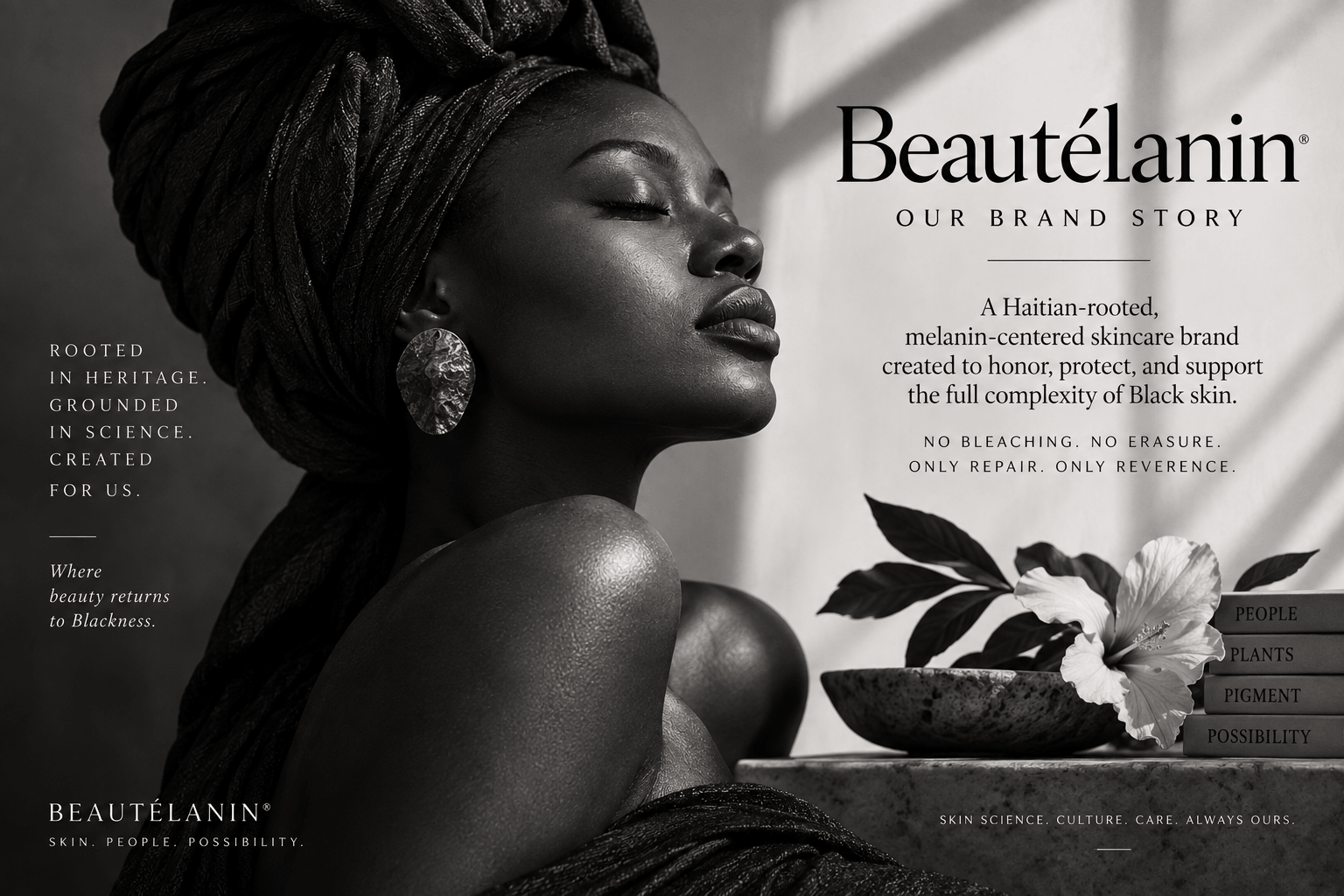
Beautélanin® Brand Story | Haitian Heritage, Black Skin & Melanin-Centered Skincare
The Origin: The Questions That Wouldn't Leave Me
Beautélanin® did not begin because I believed the world needed another skincare brand. It began because I kept encountering questions about melanin-rich skin that the education available to me did not fully answer.
As I studied formulation and later entered esthetics school, I became increasingly interested in the gap between what I was learning about skin anatomy and what I was observing in the behavior of melanin-rich skin. The textbooks taught me the structures. They taught me the conditions, the lesions, the ingredients, and the protocols. That knowledge mattered, and it still does. But I kept wanting to go further.
Why can inflammation remain biologically significant when redness is difficult to see? Why does one person's skin recover from an intervention while another person's skin preserves the event through pigmentation for months? Why can skin appear oily while simultaneously behaving as though its barrier is struggling? Why do we sometimes begin treating the dark mark before asking what happened to the skin that produced it?
Those questions stayed with me.
And eventually, they became Beautélanin®.
The Gap: When Description Is Not Yet Understanding
The deeper I studied skin, the more I realized that esthetics has become remarkably good at describing what is visible.
We can identify oiliness, dehydration, pigmentation, congestion, texture, lesions, visible vascular changes, and signs of aging. We can classify, photograph, measure, and compare. But description is not always understanding.
Two clients may present with discoloration that appears remarkably similar while carrying completely different histories. One may be preserving the memory of acne-related inflammation. Another may be experiencing hormonal pigment change. Another may have a history of friction, ultraviolet exposure, barrier disruption, eczema, or previous procedures.
The pigment may look similar.
The biological stories are not.
That distinction changed the way I thought about skincare. I no longer wanted to begin with the question, “What product treats this?”
I wanted to understand what happened first. What is the skin doing? How has it behaved over time?What does the client report? Where is the behavior occurring? What contextual factors may be relevant? What evidence does not fit our first interpretation? And perhaps most importantly: What does this skin need from us today and what should we avoid doing to it?
That became the beginning of a different way of reading the skin.
The Turning Point: From Skin Type to Skin Behavior
I did not want to discard traditional esthetics. Anatomy matters. Skin conditions matter. Ingredient science matters. Visual and tactile assessment matters.
I wanted to build upon them.
My background in law had already taught me something that became unexpectedly valuable in the treatment room: never confuse an observation with a conclusion.
Gather the evidence. Listen to the history. Consider the context. Look for patterns. Notice contradictions. And when the evidence conflicts, investigate the conflict rather than forcing it into the nearest available category.
That reasoning became central to the Beautélanin® Clinical Skin Behavior Assessment Methodology.
Instead of permanently defining a client by a conventional skin-type label, we document how the skin is presenting and behaving at a particular point in time and within the context of its history. The client's story matters. The practitioner's observation matters. The condition of the barrier matters. The pattern matters. Previous responses matter. Environmental exposure matters.
And when technology is used, the machine's interpretation becomes another piece of evidence, not an unquestionable conclusion. The goal is not diagnosis. The goal is structured esthetic reasoning.
Our Philosophy: Behavior Before Assumption
Today, Beautélanin® is grounded in NoirScience™, our broader philosophy for studying, formulating for, and caring for melanin-rich skin with scientific curiosity, cultural awareness, and respect for biological individuality.
Within that philosophy, the MRBUP® Framework gives us five domains through which we can organize and interpret skin behavior: Melanin Density, Reactivity, Barrier Behavior, UV Legacy, and Pigment Memory. These domains do not exist independently. They interact.
A compromised barrier may coincide with increased reactivity. Repeated inflammatory activity may be associated with persistent pigment memory. High sebaceous activity may coexist with surface dehydration. A client's ultraviolet and environmental history may help us understand patterns that today’s appearance alone cannot explain.
MRBUP® therefore does not give us permission to make assumptions about the skin. It asks us to gather better evidence.
Through Pattern Mapping™, we also examine where behavior occurs rather than allowing a whole-face label to erase regional differences. Through longitudinal reassessment, we ask what changed, what remained stable, what appeared after treatment, and whether the skin's response was immediate or delayed.
The numbers do not define the person. The profile matters more than the score. And the assessment is never more important than the human being sitting before us.
How We Formulate: Support the Biology Before Chasing the Symptom
The same philosophy influences how we think about formulation. We do not assume melanin is something to suppress. We begin by asking what may be influencing melanocyte behavior. We do not automatically interpret oil as a problem to eliminate. We consider what is occurring alongside that sebaceous activity. We do not treat exfoliation as evidence that a treatment is working simply because something is peeling. We consider the barrier that must recover afterward.
This does not mean Beautélanin® rejects corrective skincare. Clients come to us with concerns, and those concerns deserve to be taken seriously. Hyperpigmentation can be distressing. Acne can be painful. Barrier disruption can be uncomfortable. Texture changes can matter deeply to the person experiencing them.
Respecting the skin doesn't require pretending those concerns don't exist. It means we refuse to pursue improvement at the expense of understanding.
Our formulations and protocols therefore begin with a different premise: Support the function. Understand the behavior. Then determine what intervention the skin can reasonably tolerate.
Where Heritage Meets Science
Beautélanin® is also inseparable from my Haitian heritage. But I don't believe honoring ancestral knowledge requires romanticizing it, just as respecting modern science doesn't require pretending science has answered every question.
I grew up within a culture where plants, oils, teas, bathing rituals, touch, food, family knowledge, and care of the body existed long before I knew the scientific terminology that might explain some of those practices.
Today, I can hold both forms of knowledge with respect. I can ask what tradition observed. I can ask what science has demonstrated. I can ask where evidence is emerging. And I can acknowledge when we simply do not know yet. That is ancestral reverence with scientific precision.
Our heritage inspires curiosity. Science helps us interrogate that curiosity. Neither requires the silencing of the other.
The Client: Not a Condition, but a Source of Evidence
Perhaps one of the most important changes in Beautélanin® has been the way we think about the person receiving the treatment.
Before examining the skin, we listen. What brought you here? When did you first notice the change?What happened before it appeared? Does it disappear and return? What makes it worse? What seems to improve it? What happens after irritation? How long does your skin take to feel like itself again? What changed after pregnancy, stress, travel, illness, a new product, a procedure, a season, or a move to a different climate?
The answers do not diagnose the client. They give us context. A client is not simply the person we assess. The client is part of the evidence.
Their history cannot be erased simply because today's photograph looks different. Their report of burning does not become irrelevant because erythema is difficult to appreciate visually. Their history of six-month pigment persistence matters even when today's discoloration appears mild.
We believe good skincare begins when the practitioner learns to listen as carefully as they look.
The Transformation We Seek
Our goal is not to promise flawless skin.
It is not to make every pore disappear, every wrinkle vanish, every complexion become uniform, or every person leave looking like the same interpretation of “healthy.” The transformation we seek is more thoughtful than that.
We want clients to understand their skin well enough to recognize its patterns.
We want practitioners to become confident enough to say, “I don't have enough evidence yet,” rather than forcing an interpretation.
We want treatment decisions to become less reactive. We want barrier recovery to matter as much as immediate results. We want the absence of visible redness to stop being mistaken for the absence of inflammatory experience. We want pigmentation to be investigated as a biological response rather than automatically approached as an enemy. And sometimes, we want an assessment to lead to the most responsible treatment decision of all: Not today.
Because a good assessment should tell us not only what we can do. It should help us recognize what we should not do to this skin today.
The Mission Continues
Beautélanin® continues to grow beyond products.
We are building education, practitioner training, formulation principles, assessment methodologies, clinical observation tools, treatment protocols, visual resources, and a body of work dedicated to understanding melanin-rich skin with greater depth.
We are still asking questions. We are still studying. We are still refining our language. We are still willing to change our conclusions when better evidence requires it. That matters to me because Beautélanin® was never created to replace one rigid standard with another.
It was created to make room for better observation. Better questions. Better reasoning. And ultimately, better care.
Our work begins with melanin-rich skin because too many of its biological stories have been compressed into categories that do not always tell us enough.
But our larger principle is profoundly human: No person's skin should be reduced to what can be seen in a single moment.
Skin has history. Skin has context. Skin adapts. Skin responds. Skin changes. And when we learn to examine those behaviors together, we begin to see something far more meaningful than a skin type. We begin to see the story.
Our Guiding Principle
Traditional skin analysis teaches us to recognize what is present. Beautélanin® teaches us to organize the evidence, understand how the skin is behaving, and ask what it needs before deciding what we should do next.
That is Beautélanin®.
Ancestral Reverence. Scientific Precision. Radical Self-Respect.
Beautélanin™ articles are for education only and do not replace medical advice.
