
Decolonize How We Treat Our Melanated Skin
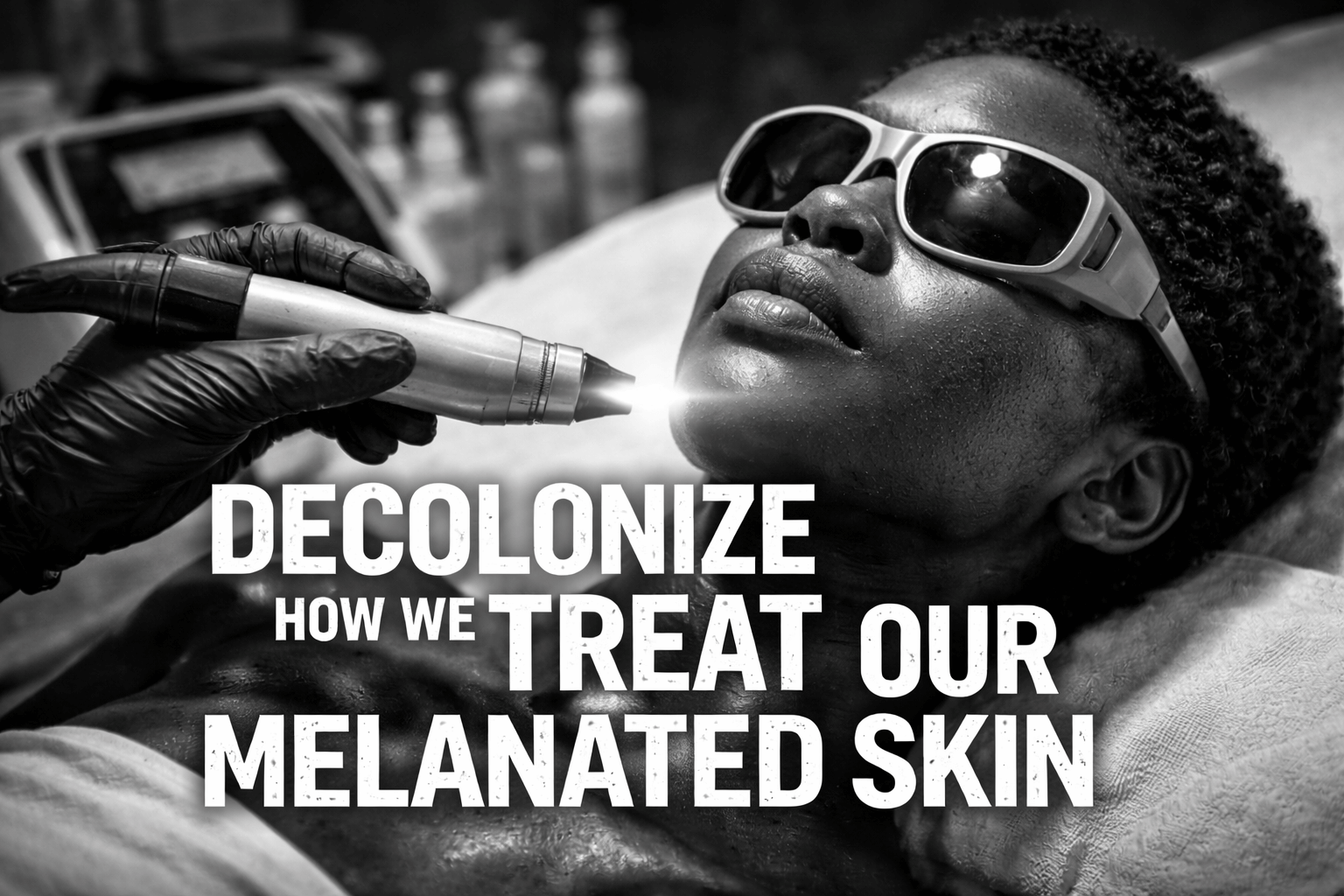
Black-and-white editorial portrait of a woman with melanated skin highlighting melanin as protection, resilience, and heritage in support of decolonized skincare and melanin-centered skin education
For generations, many of us have been taught to approach our skin as a problem to solve.
The message appears in different forms. Sometimes it arrives through advertisements promising brighter, clearer, lighter, or more even skin. Sometimes, textbooks devote pages to wrinkles and photoaging while barely acknowledging conditions that disproportionately affect people with melanin-rich skin. Sometimes it is passed down through well-intentioned advice from family members who learned to navigate a world where lighter skin was often treated as more desirable, more acceptable, or more beautiful.
The language may change, but the message remains remarkably consistent.
Your skin is too dark.
Your pigment is too noticeable.
Your texture is too coarse.
Your oil production is excessive.
Your hyperpigmentation is unacceptable.
Your aging should be hidden.
Over time, these messages become so familiar that we stop questioning them. We begin to see them as facts rather than cultural assumptions. We mistake beauty standards for biology and marketing narratives for scientific truth.
To decolonize skincare is to challenge those assumptions. It is to ask who created the standards we inherited, whose skin was centered when those standards were developed, and what happens when entire populations are expected to measure themselves against ideals that were never designed with them in mind.
Melanin Is Not a Defect to Correct
One of the most persistent misconceptions in skincare is the idea that melanin is primarily a cosmetic feature. We are taught to think of melanin as the substance responsible for skin color and little else. Yet from a biological perspective, melanin is far more sophisticated than the beauty industry often acknowledges.
Melanin plays a role in the skin’s defense system. It absorbs ultraviolet radiation, helps reduce certain forms of oxidative damage, and helps protect cellular structures from environmental stress. It is dynamic, responsive, and highly adaptive.
When melanocytes increase pigment production following inflammation or injury, the response is often treated as a malfunction. Hyperpigmentation is framed as something to erase as quickly as possible. Yet from the skin’s perspective, pigment production is frequently a protective response. The skin is responding to perceived threat, attempting to shield vulnerable tissues, and engaging mechanisms that have evolved over thousands of years.
This does not mean hyperpigmentation is always desirable or that individuals should not seek treatment when it affects their quality of life. It means we should understand the biological purpose before rushing to suppress the response.
Decolonizing skincare requires us to move away from viewing melanin as an obstacle and toward understanding it as an active participant in skin health.
The Legacy of Eurocentric Beauty Standards
Modern skincare did not emerge in a cultural vacuum.
Many of the beauty standards that dominate today’s industry were shaped during periods in which European features and lighter skin tones were positioned as ideals. These standards influenced everything from advertising and cosmetic development to scientific research and professional education.
As a result, generations of consumers learned to associate lighter skin with health, refinement, beauty, and social mobility. Even when modern marketing avoids explicitly promoting these ideas, their influence often remains embedded within product categories and treatment philosophies.
Consider the language commonly used in skincare.
Brightening.
Lightening.
Correcting.
Fixing.
Improving.
While these terms may appear neutral, they often reflect assumptions about what skin should look like and which characteristics are considered desirable.
When darker pigment is routinely framed as a problem requiring intervention, the message extends beyond cosmetics. It influences how people perceive themselves and how professionals are trained to evaluate skin.
Decolonizing skincare means recognizing that not every aesthetic preference is biologically necessary and not every beauty standard is culturally neutral.
The Brightening Industry and the Suppression of Pigment
Few categories illustrate this tension more clearly than the global brightening market.
Billions of dollars are spent each year on products designed to reduce, suppress, or alter pigment production. Many of these formulations target tyrosinase, an enzyme involved in melanin synthesis. The goal is often presented as achieving a more even complexion, but the broader cultural context cannot be ignored.
When an industry consistently profits from reducing visible pigment, we must ask what assumptions are driving consumer demand.
This does not mean every pigment-correcting treatment is inherently harmful. Hyperpigmentation can be emotionally distressing and may significantly impact self-confidence. Melanin is not merely responsible for skin color. It participates in photoprotection, helps absorb ultraviolet radiation, and contributes to the skin's ability to respond to environmental stress. Any discussion about reducing pigment should begin with an understanding of the biological function that pigment serves.
Decolonized skincare requires nuance. It asks us to distinguish between supporting healthy skin function and encouraging the suppression of biological traits simply because they do not align with dominant beauty standards.
Aging Is Not an Emergency
The beauty industry has built an enormous economy around the fear of aging.
Consumers are encouraged to monitor every fine line, every crease, and every visible sign of maturity. Entire product categories are designed around the promise of reversing time.
Yet aging is not a disease.
It is a biological process.
For individuals with melanin-rich skin, visible aging often follows patterns that differ from those commonly depicted in mainstream beauty campaigns. Pigmentation changes may appear before wrinkles. Volume loss may become noticeable later. The timeline and presentation are not identical.
More importantly, the goal of skincare should not be perpetual youth.
Healthy skin is not defined by the absence of age. It is defined by function, resilience, comfort, and integrity.
Decolonizing skincare means rejecting the notion that every sign of aging represents failure. It means understanding that a life well lived will leave its mark and that those marks do not diminish our worth.
Moving From Control to Care
Many traditional skincare narratives are built around control.
Control oil.
Control pigment.
Control aging.
Control texture.
Control shine.
Control the skin.
Yet skin is not a machine that exists to obey our commands. It is a living organ constantly responding to hormones, climate, stress, nutrition, environment, and experience.
Rather than asking how to control the skin, perhaps we should ask how to support it.
What does the barrier need?
What is inflammation communicating?
What environmental stressors are present?
How can we promote resilience rather than suppression?
These questions shift the focus from domination to partnership. And partnership is often where healing begins.
The Beautélanin™ Philosophy
At Beautélanin™, we believe melanated skin does not need to be corrected to be acceptable. It deserves to be understood.
Our approach is rooted in the belief that melanin is not a flaw, that barrier health matters, that inflammation should be respected, and that skincare should support the biological intelligence of the skin rather than wage war against it.
We do not believe the goal is perfection. We believe the goal is preservation. Preservation of barrier integrity. Preservation of pigment health.
Preservation of cultural knowledge. Preservation of cultural knowledge means recognizing that beauty practices did not begin in laboratories. Long before modern skincare existed, communities around the world developed rituals, botanicals, cleansing traditions, and healing practices rooted in observation, experience, and care. Decolonizing skincare requires acknowledging that scientific knowledge and cultural knowledge are not enemies. Both have something to teach us.
Finding local healers, reading about ingredients used in your community’s past, or simply asking family members about remedies and routines from home can foster a deeper sense of empowerment and cultural pride. These small acts of remembrance help ensure traditions are not lost, but celebrated and woven into modern care.
Preservation of the relationship between people and the skin they inhabit.
Because decolonizing skincare is ultimately about more than products.
It is about perspective.
It is about rejecting narratives that teach us to distrust our biology and replacing them with knowledge that allows us to understand it. One way to begin this process is by practicing self-affirmation. Consider using affirmations such as, "My skin is an expression of my heritage, strength, and beauty," or "I honor and appreciate the unique qualities of my skin." Joining supportive communities or sharing your healing journey with others can also help dismantle internalized negativity and encourage self-acceptance. By actively choosing positive self-talk and seeking encouragement from those who celebrate our diversity, we give ourselves space to heal and embrace our authentic selves.
The most radical act may not be changing your routine. It may be changing the question. Instead of asking, “How do I fix my skin?” Ask, “How do I support the skin that has been protecting me all along?”
References
(n.d.). Skin Lightening Products Market Size & Outlook, 2030. https://www.grandviewresearch.com/horizon/outlook/skin-lightening-products-market-size/global
(2016). Skin whitening agents: medicinal chemistry perspective of tyrosinase inhibitors. PMC6010116. https://doi.org/10.1016/j.bmc.2016.09.004
(2022). Melanin: What Is It, Types & Benefits. Cleveland Clinic. https://my.clevelandclinic.org/health/body/22615-melanin/
Castanet, J. & Ortonne, J. (1997). Pigmentary Changes in Aged and Photoaged Skin. Arch Dermatol 133(10). https://doi.org/10.1001/archderm.1997.03890460120015
Hernandez, M. P. (April 15, 2024). 4 herbal traditions used every day, all over the world. National Geographic. https://www.nationalgeographic.com/premium/article/herbs-traditional-medicine-everyday
Beautélanin™ articles are for education only and do not replace medical advice.
