
Decolonize How We Treat Our Melanated Skin
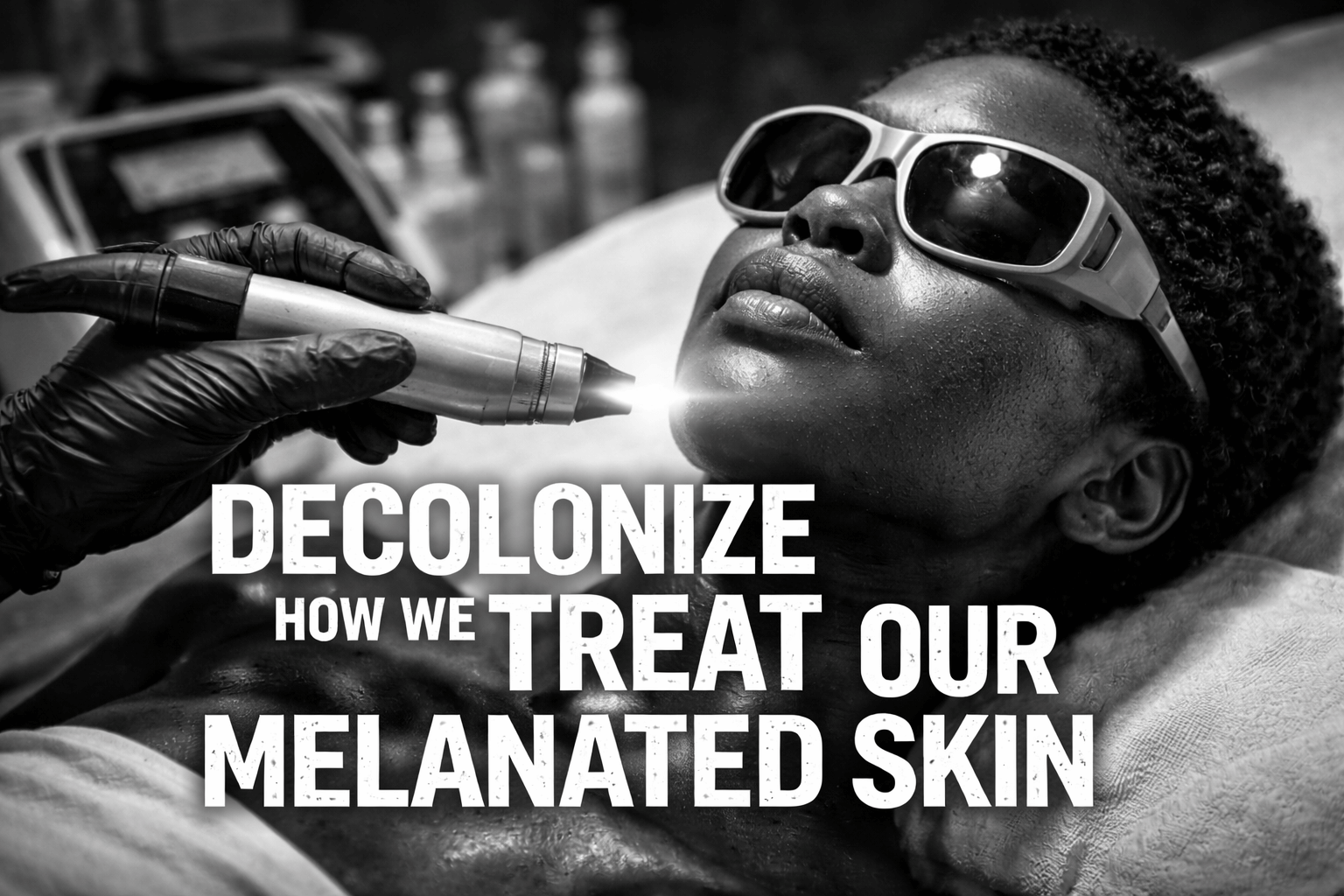
They’ve taught us to be at war with the very thing that protects us.
From the first textbook to the first product recommendation, the message has been clear: your skin is a problem to solve. Your melanin is too much. Your texture is too unruly. Your oil production is too active. Your hyperpigmentation is a flaw. Your aging, a failure. Every inch of your being has been framed as something to fix, shrink, or correct.
But let me remind you: melanated skin was never the problem. The problem is the lens through which it’s been viewed.
Melanin Is Not a Mistake. It’s a Memory.
Your skin holds more than cells: it holds ancestral memory. Melanin is not a cosmetic feature. It is your skin’s built-in protection, your chemical shield, your spiritual recall. It is intelligent, dynamic, and responsive.
When your skin darkens or hyperpigments, that’s not dysfunction. That’s your skin doing its job, activating melanin to protect your DNA from harm, from inflammation, from stress. That patch of darkness they told you to bleach? It’s not a blemish. It’s a badge of defense.
Decolonizing your skincare means reframing what melanin is: not a flaw to fade, but a sacred function to support.
The Industry Doesn’t Understand Us Because It Wasn’t Built For Us
Let’s be honest: the skincare industry wasn’t made with us in mind. From ingredients that disrupt hormones to treatments that ignore our unique healing processes, we’ve been force-fed a regimen that doesn’t reflect our biology or our beauty.
Retinol, acids, tyrosinase inhibitors; these are often marketed as “miracle” fixes. But for melanated skin, they’re often triggers for inflammation, photosensitivity, and damage.
Why? Because most of these protocols were developed and tested on skin that lacks melanin altogether.
The result? Our skin suffers from treatments that were never meant to serve it.
Let’s Talk About Brightening, Because They Never Meant Glow
The word brighten shows up in every aisle, every ad, every shelf. But ask yourself: what is it really trying to erase?
In most formulations, brightening doesn’t mean radiance. It means suppression, blocking the enzyme tyrosinase, which is essential for melanin production. In other words: they’re telling your skin to stop protecting itself.
This is not skincare. This is chemical disarmament.
To decolonize skincare, we must stop equating lightness with health and instead reclaim our glow without silencing our pigment.
We Don’t Age Like They Do, Because We Live Differently
They say we age slower because of eumelanin. But let’s go deeper. We age differently because we move differently through this world. We’ve had to dance grief into joy, sing survival into rhythm. Our ancestors carried trauma and still knew how to carry laughter too.
We don’t need to fight aging. We need to restore the environments that allow our skin to rest, to heal, to reflect our truth, not our exhaustion.
Anti-aging culture is a panic built on privilege. Decolonized skincare honors aging as a story, not a symptom.
Your Skin Doesn’t Need Control. It Needs Care.
Everything we’ve been taught about skincare has been about control; tighten, tone, lighten, suppress. But melanated skin responds best to support, not subjugation.
What we need is:
Formulas that protect and nourish, not attack
Rituals rooted in repair, not reaction
Care that is cultural, biological, and spiritual
To decolonize skincare is to return to restorative beauty, the kind that listens before it acts and remembers before it strips.
Beautélanin Isn’t Here to Sell You Perfection. We’re Here to Protect What Protects You.
Our formulations don’t quiet your melanin, they celebrate it. Our treatments aren’t here to shame your skin, they remind it who it is. We are not promising transformation; we are offering remembrance. Because the goal isn’t to look like you’ve never lived. The goal is to live full, and let your skin reflect that truth with grace, power, and integrity.
Final Word
To decolonize your skincare is not just to change your products. It’s to change your perspective. To stop asking, “How do I fix my skin?” and start asking, “What does my skin need to feel safe, heard, and seen?” Because the most radical thing you can do is honor your melanin as medicine, not mistake.
