
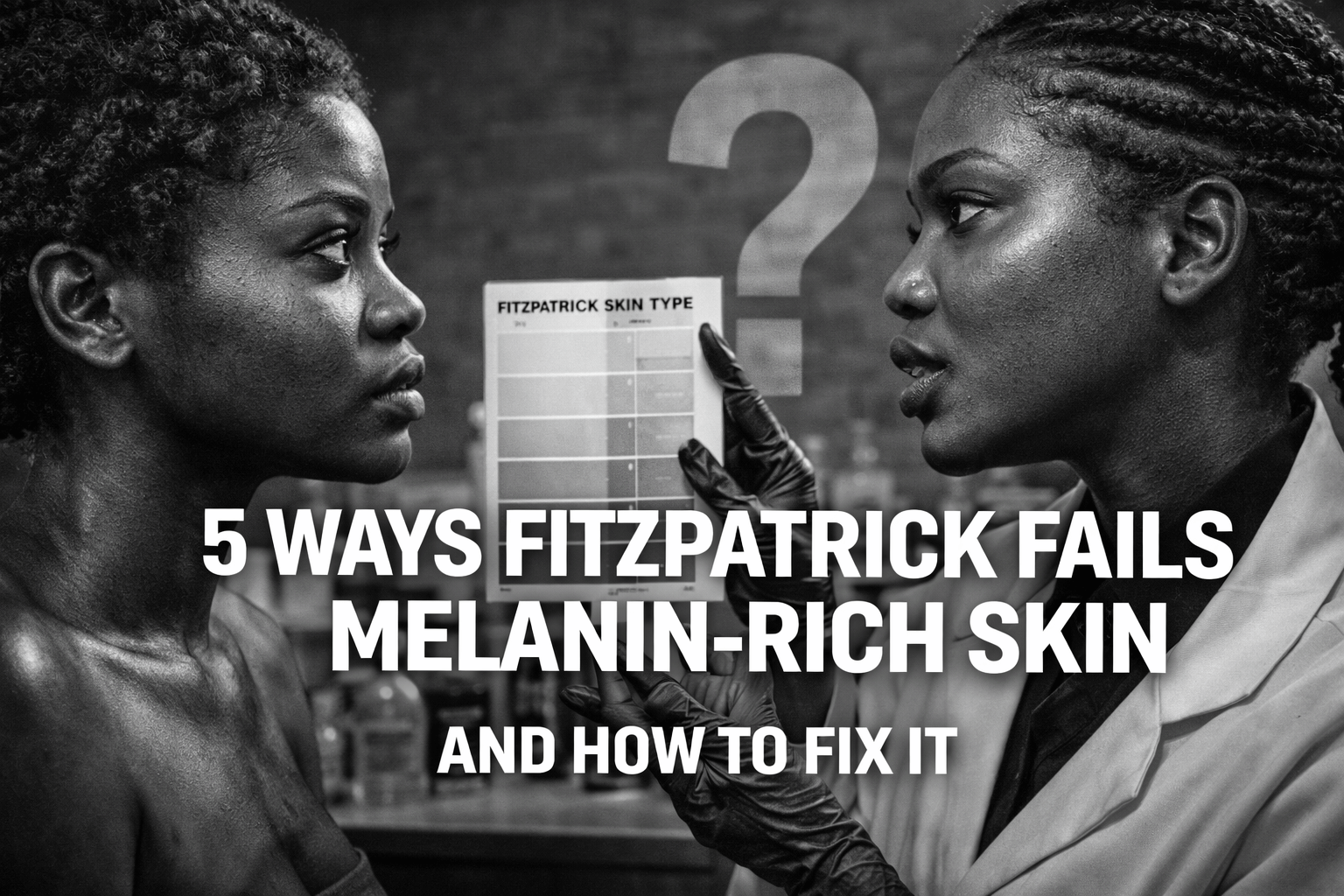
5 Ways Fitzpatrick Fails Melanin-Rich Skin (And How to Fix It)
The Fitzpatrick Scale was never built for melanin-rich skin—and it shows.
Developed in the 1970s to measure how pale skin burns or tans, the Fitzpatrick system reduces skin health to sun reactivity while ignoring the biological intelligence, memory, and resilience of Black and brown skin. What it labels as “less sensitive” or “lower risk” often translates into misdiagnosis, overtreatment, and long-term pigment trauma for melanated individuals.
This guide breaks down five critical ways Fitzpatrick fails melanin-rich skin, from its reliance on visible redness to its silence on pigment memory, barrier health, and lived environmental history. More importantly, it offers a path forward. Through NoirActive™ and the MélanoMatrix-D™ (M–R–B–U–P™) functional profile system, we introduce a melanin-centered diagnostic approach that prioritizes protection over suppression and understanding over approximation.
If you’ve ever been told your skin is “hard to treat,” “prone to hyperpigmentation,” or “too sensitive for results,” the problem is not your skin. It’s the framework. And it’s time to replace it.
Decolonize How We Treat Our Melanated Skin
The Industry Doesn’t Understand Us Because It Wasn’t Built for Us
Let’s be honest. The skincare industry was not designed with melanated bodies in mind.
From ingredients that disrupt hormonal balance to protocols that ignore how melanin responds to trauma, inflammation, and healing, we have been handed systems that do not reflect our biology or our lived realities. Treatments are labeled “universal,” yet tested on skin that lacks melanin altogether.
Retinoids, acids, tyrosinase inhibitors, marketed as miracle solutions, often become triggers for melanated skin, provoking inflammation, photosensitivity, and long-term damage. Not because our skin is “difficult,” but because the science never centered us.
The result is predictable: harm framed as progress.