
The Silence Around DPN: What They Don’t Teach You
The beauty industry spends billions every year on “anti-aging.” Retinol, peels, lasers, injectables, campaigns engineered to convince white consumers their skin is always one wrinkle away from collapse. These are the products that get the research dollars, the glossy textbook mentions, the marketing machine.
Meanwhile, conditions that disproportionately affect us such as Dermatosis Papulosa Nigra (DPN) barely register in the canon.
Milady’s esthetics textbook, the so-called “industry bible,” devotes chapters to wrinkles, acne, and pigmentation. Yet nowhere does it even name DPN, even though it is a common, visible, genetic condition in melanin-rich skin. That omission is violent in its own way: it teaches generations of estheticians that our skin concerns are not worth mentioning.
The Numbers They Don’t Want You to See
The beauty industry spends an estimated $62–80 billion globally on anti-aging skincare: retinols, peels, injectables, and so-called “brightening” products. The models who benefit most from this war on aging are white-skinned, while melanin-rich populations are left out of the narrative.
On acne, the industry invests about $11 billion worldwide. Yet, even though research is broad, the framing and treatments remain overwhelmingly Eurocentric.
To erase what is rightfully yours, the industry funnels $9–12 billion annually into “skin brightening” and bleaching agents. Make no mistake, this is not for your benefit. These products exist to uphold and profit from anti-melanin bias.
Meanwhile, on conditions like Dermatosis Papulosa Nigra (DPN), which primarily affects people of African ancestry, the industry spends virtually nothing. To date, I’ve only found reference to a single small California study, which may not even still be active. This silence makes it clear: melanin-rich skin is ignored, except when it can be erased or pathologized.
What This Means
Instead of supporting the skin barrier, industry “solutions” often strip it:
Harsh retinoids → inflammation, hyperpigmentation in melanin
Aggressive chemical peels → PIH, barrier breakdown
Lasers → scarring, inconsistent results on darker skin tones
For us, these are not “treatments.” They are risks. DPN, while stigmatized, is benign. But when treated with methods designed for white skin, the outcome is often worse than the lesion itself.
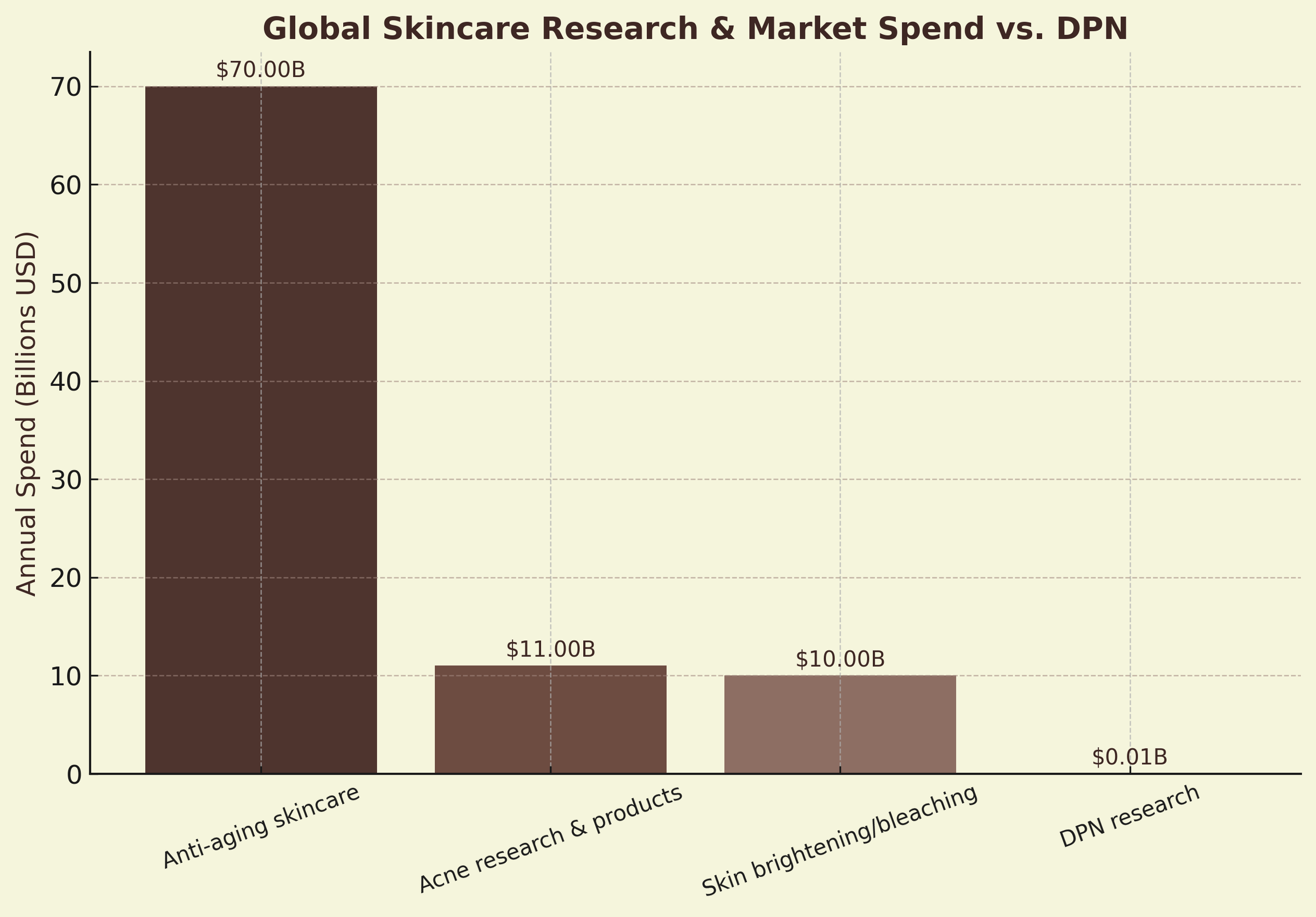
This chart shows the billions spent on anti-aging, acne, and brightening compared to the near-zero for DPN.
Our Approach
At Beautélanin™, we refuse the erasure. Our philosophy is clear:
We name what they erase. DPN exists, and it deserves recognition.
We protect, not punish. No stripping, no bleaching, no false “anti-aging” panic.
We research for us. Melanin-safe support that slows triggers, strengthens the barrier, and reduces irritation.
Because unlike the textbooks, we will not leave our skin out of the conversation.
Beautélanin™ Ingredient Education: What Each Active Does for Melanin-Rich Skin
Here are some of the key ingredients we use (or plan to use) in our formulations, and how they support your melanin, your barrier, and your skin health, especially around conditions like DPN.
β-Glucan (from oats or mushrooms)
A Polysaccharide from oat cell walls or fungi. It is known for having properties that calm inflammation, accelerates recovery, supports barrier integrity, helps shield from environmental stress.
Ectoin
A natural osmolyte produced by bacteria; stabilizes cell membrane. It helps reduce water loss (TEWL), calms skin irritated by dryness or external stress, supports barrier repair.
Niacinamide (Vitamin B3)
A water-soluble vitamin. It helps regulate sebum (less irritation), supports even texture, reduces the transfer of pigment (thus preventing darker marks around lesions), reduces inflammation.
Pumpkin Enzyme
A proteolytic enzyme derived from pumpkin pulp. Gentle exfoliation: this enzyme removes dead surface cells without harsh scrubbing, increases clarity and smoothness, helps prevent buildup around DPN lesions without triggering flare-ups.
Colloidal Oat / Oat Beta-Glucan
Finely milled oat particles + polysaccharides. This ingredient soothes itch, calms irritation, forms a protective film, helps reduce redness, supports comfort (important around raised lesions).
Saccharide Isomerate
This is a plant-derived complex sugar (like “plant derived natural moisturizing factor”). It is a long-term hydration bind, that improves the “moisture memory” of the skin barrier so skin stays supple and less reactive.
Squalane / Tamanu / Moringa Esters (light oils)
The ingredients are Lipid-rich plant esters/emollient oils. They replace lost lipids in the skin barrier in skincare products, reduce surface friction, so that raised lesions like DPN don’t get aggravated by dryness or movement.
Bisabolol, Allantoin, Panthenol
These ingredients are botanical amide / pro-vitamins, known for their anti-inflammatory, anti-irritant properties to help calm oxidative stress, support skin comfort around sensitive raised areas.
Citations
Sousa, P. et al. “β-Glucan extracts as high-value multifunctional ingredients …” ScienceDirect / PubMed. 2023. PubMed
Załęska, I. et al. 2025. “Influence of Ectoine on the Skin Parameters Damaged …” MDPI. MDPI
WebMD: “Niacinamide uses for skin: Benefits and side effects” (Sep 2024). WebMD
Hseu et al., 2020. “The Skin-Whitening Effects of Ectoine via the Suppression of α-MSH-Stimulated Melanogenesis …” PMC. PMC
Naturopathica: “What Does Pumpkin Enzyme Do For the Skin” (recent). Naturopathica
Helpful Tips for Reading Labels & Products
Always check if ingredients are in safe concentrations (e.g. low-moderate percent for enzyme, niacinamide under ~5% for sensitive skin).
Fragrance, high alcohol, high acid strengths are more likely to irritate melanin-rich skin.
Avoid layering multiple “active” exfoliants at once (e.g. enzyme + retinoid + acid), especially near DPN lesions.
Disclaimer
The information provided here is for educational purposes and does not substitute medical advice. Always do your own patch test and consult a dermatologist for persistent skin conditions or before starting new skincare, especially if you have inherited skin concerns like DPN.
