
Why Melanin-Rich Skin Must Stop Following Industry Trends
Because they were never talking about us in the first place
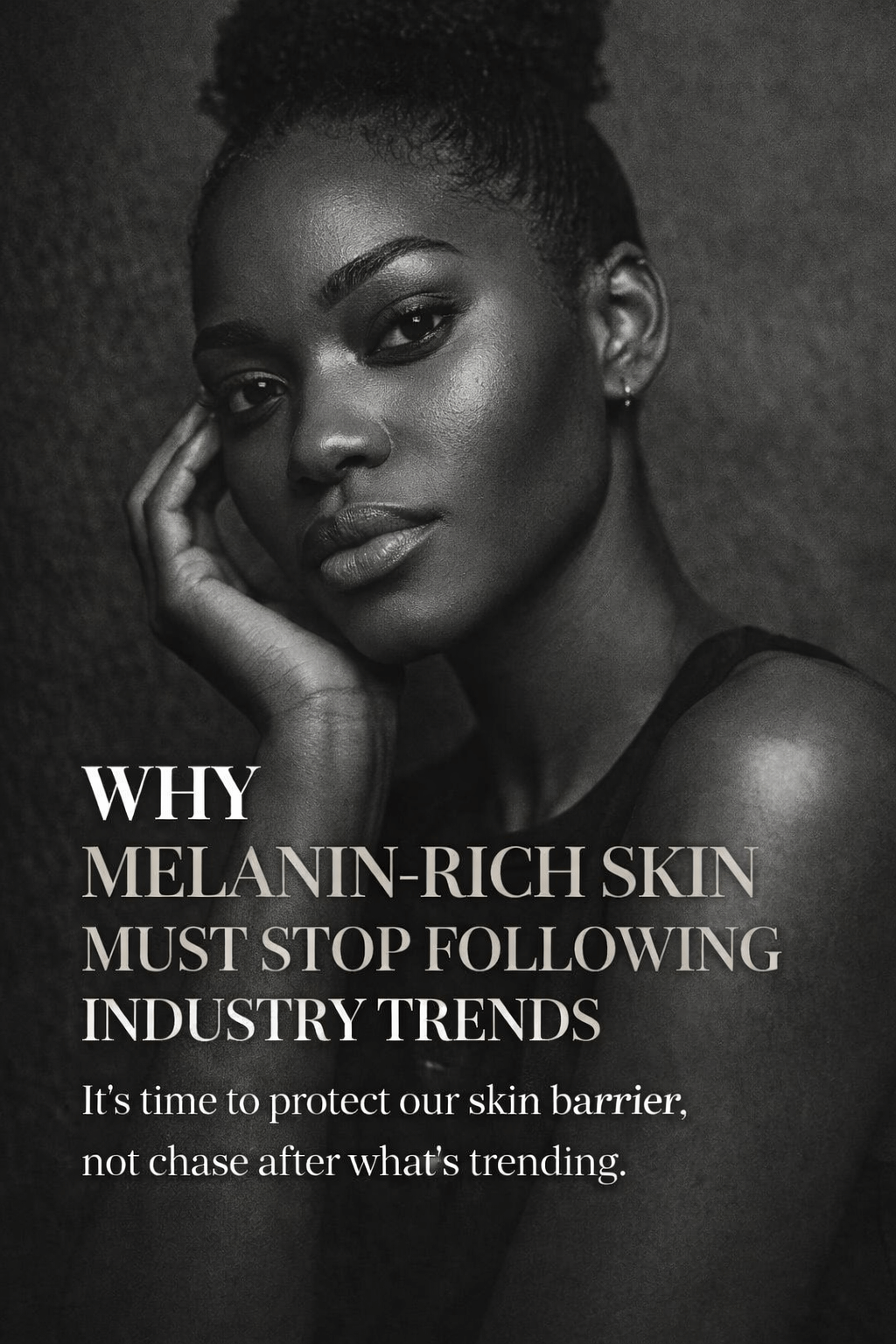
The beauty industry is loud about trends, dermaplaning, retinol, Vitamin C, chemical peels, microneedling. Each cycle, a new “holy grail” is crowned. The marketing is glossy, the promises endless. And always, the claim: “safe for all skin types.”
But here’s the truth: they were never talking about us.
The Problem With “Universal” Language
When you read “safe for almost everyone” or “suitable for all skin types”, what they really mean is: tested on pale skin, marketed to pale skin, and studied through the lens of pale skin’s responses.
In lighter skin, inflammation shows as redness, peeling, or quick burns.
In melanin-rich skin, inflammation shows as hyperpigmentation, dark patches, and scars that may last for months or years.
Yet, our outcomes are erased from the fine print.
The Trend Trap
Take dermaplaning. Industry blogs call it “gentle,” “safe,” and a “skin revival.” But what they never explain is how a single nick or scrape on melanin-rich skin can trigger post-inflammatory hyperpigmentation (PIH), keloid scarring, or chronic texture changes.
Or consider the obsession with Vitamin C. It’s pushed as the miracle brightener, but not a word is spoken about its instability, the risk of irritation, or how it can overstimulate melanocytes when layered onto a freshly disrupted barrier.
The “holy grail” becomes our headless horseman: unstable, untested, and unanchored for melanin.
Why Melanin Needs Anchoring, Not Erasure
Melanin is not a flaw to be polished away. It is our skin’s shield; absorbing UV radiation, fighting free radicals, and remembering assaults so the body can survive.
Hyperpigmentation is not “ugly”; it is testimony that your defense system is working.
Darkness around the eyes or jawline is not “dirty”; it is melanin memory etched by sun and stress.
DPN, keloids, or patches of pigmentation are not “mistakes”; they are our biology protecting itself differently.
The industry tells us to strip, peel, bleach, and brighten. But what melanin needs is to repair, support, and anchor.
The Cost of Following Them
Black and brown communities are taught that sunscreen is optional. We are under-educated about cancer risk. By the time melanoma is diagnosed, our survival rate drops to 66%, compared with 90% in White patients. At the same time, skin-lightening products and tyrosinase suppressants flood our markets, nearly twice as common in our communities as sunscreen use.
The equation is violent and intentional:
They sell us suppression.
They deny us protection.
And then they blame our melanin for “failing.”
The Way Forward
It’s time to stop following trends not made for us. It’s time to build rituals rooted in truth:
Barrier-first care: oils, ceramides, humectants, and ancestral hydrators like Haitian castor, moringa, and tamanu.
Respectful renewal: enzymes, mandelic acid, snow mushroom, gentle allies that work with melanin’s rhythm.
Anchored protection: sunscreen without bleaching claims, paired with antioxidants that preserve pigment integrity.
Education over erasure: naming PIH, DPN, keloids, and melanin responses without shame, so future generations are not erased by blanket marketing.
“Melanin-rich skin is not a trend. It is a testimony.”
Melanin-rich skin was never meant to follow their trends because those trends were never made for us. Radiance is not borrowed from a bottle; it is remembered in how we repair, protect, and honor the skin we already live in.
