
Milady Overkills Infection Control,But the Real Risk Walks in With the Client
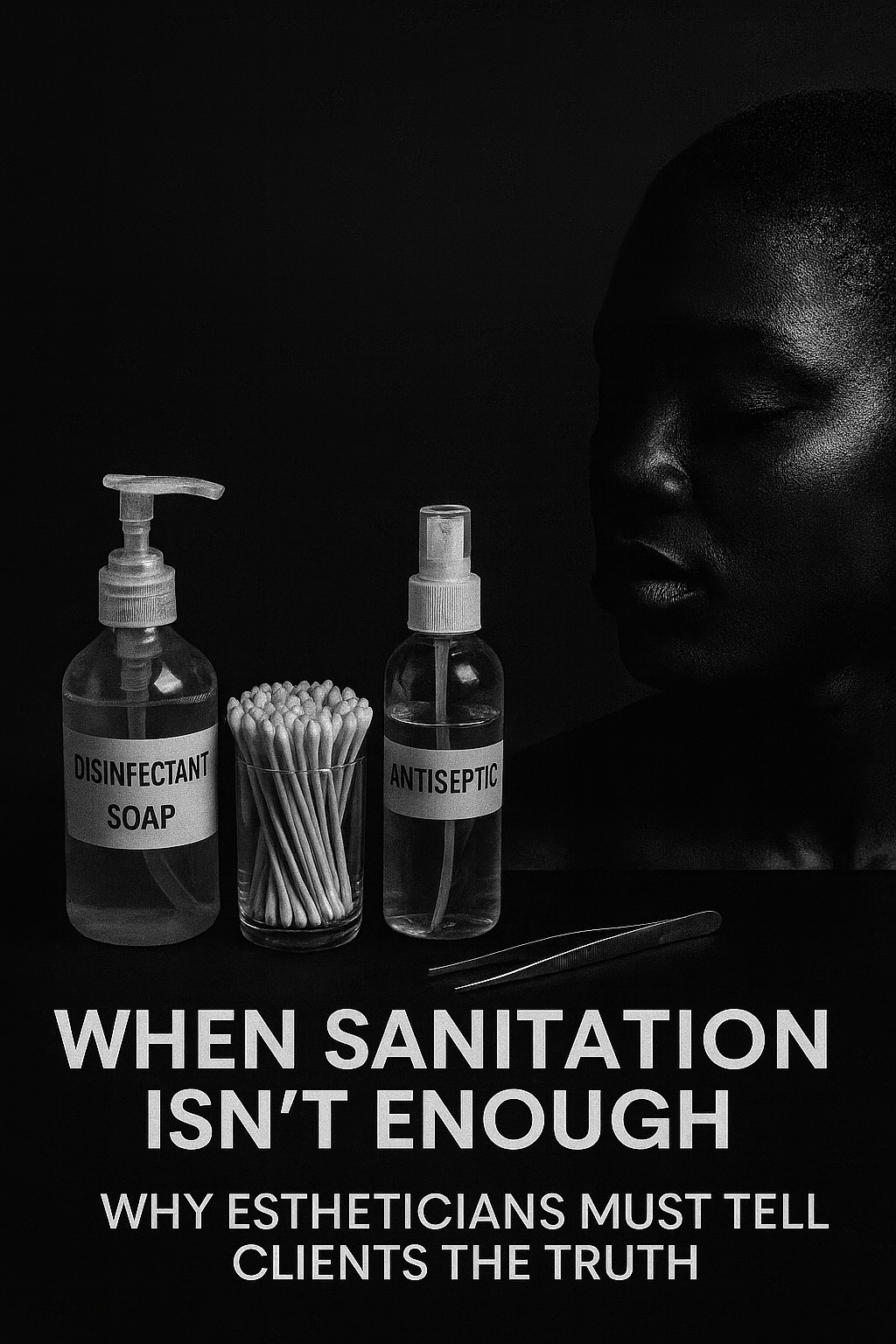
Milady spends chapters drilling us on pathogens, sterilization, disinfectants, cross-contamination, and the correct angle to hold a spatula over a test tube of Barbicide. And yes, sanitation matters. Cleanliness matters. Order and discipline matter. But let me tell you the truth Milady never prepared me for: The biggest safety risk in esthetics isn’t what’s on your counter. It’s what a client doesn’t say on their intake form.
Clean hands are not enough. This work demands clean science, clean data, and clean honesty, especially when melanin is in the room
They teach infection control like we’re all one missed wipe away from shutting down the whole spa.
But they never teach the psychology of clients, and that is where most estheticians get blindsided.
Clients don’t lie maliciously. They lie because:
they forget
they minimize
they assume
they think it’s “not important”
they don’t understand the ingredient words on their own labels
they truly don’t know the difference between sensitivity and allergy
And I promise you, it is the ones who say, “my skin is perfect, I never react to anything,” who react the fastest. Not because they’re dramatic. But because they’ve never met someone who read their skin deeper than their confidence.
Clean tools protect the surface. Clear communication protects the person. Because the greatest risk in esthetics is not bacteria; it’s the silence around what really happens to melanin-rich skin.
Milady’s Version of a Risky Client:
Someone coughing, sneezing, bleeding, or showing signs of infection, but reality:
A risky client is someone who says “no allergies” but comes back 48 hours later with irritation.
A risky client is someone who wears heavy makeup but doesn’t tell you what’s under it.
A risky client is someone who shaved, waxed, or exfoliated the day before a service, and thinks it “doesn’t count.”
A risky client is someone who genuinely does not understand their own skin.
Milady teaches how to disinfect tweezers. But they don’t teach you how to disinfect misinformation.
The Real Infection Happens in Silence
Clients don’t realize how much their skin is telling us, even when they aren’t. They don’t mention:
the retinol they used Tuesday
the TikTok scrub they tried last week
the hair gel creeping onto their forehead
the sunburn they got at their kid’s soccer game
the fragrance-heavy moisturizer they love
the shaving or waxing they did “just a little bit”
They don’t tell you because they:
don’t know it matters
don’t want to seem difficult
don’t want to reschedule
don’t want to admit they used the wrong thing
don’t think professionals need the full truth
And this is where delayed irritation happens.
Not because you did anything wrong.
Not because your technique was flawed.
Not because your tools weren’t clean.
But because you cannot treat what you are not told.
The Part Milady Never Included
Estheticians Must Practice Defensive Skincare** This profession is not just about products and protocols. It is about people, personalities, attitudes, histories, and hidden details.
A true esthetician learns to read:
tone
body language
rushed clients
standoffish clients
clients who look nervous
clients who minimize everything
clients who want results but skip honesty
clients who are “too tough” to admit sensitivity
We are not trained to diagnose, but we must be trained to interpret. And the interpretation cannot come from the face alone. It comes from:
the intake form
the inconsistencies
the way they answered
what they didn’t answer
how early or late they showed up
the urgency in their voice
the way they talk about their skin
the gaps in their own knowledge
Milady gives us a textbook. Real clients give us a puzzle.
And especially for melanin-rich skin… the stakes are higher.
Our skin hides reactions under the surface. We don’t turn red; we turn deeper. We don’t peel; we pigment.
We don’t erupt; we shadow. We don’t inflame; we protect.
So, when something goes wrong, clients assume it “just happened.” But melanin is a protector, not a liar. When the barrier is compromised, it will show you quietly, subtly, slowly, and often 48 hours later.
The Truth Beautélanin™ Stands On
Sanitation keeps my tools clean, but honesty keeps my clients safe, and my observations keep my practice protected. I am learning to never rely on:
their memory
their confidence
their casual “oh, I’m fine”
their idea of “tough skin”
I rely on:
my (real live) training
my caution
my eyes
my intuition
my reading of melanin’s behavior
my barrier-first philosophy
my clinical restraint
my responsibility
Milady prepared me for microbes. Experience and research are preparing me for people. And honestly? People are the real test.
Milady taught us how to sanitize a spatula.
Life teaches us how to sanitize the lies.
And the biggest pathogen in this industry isn’t microbes.
it’s misinformation.
